Course Content
Dhyana Yoga
Learning meditation, concentration, inner peace, and self-control through the practice of Dhyana Yoga.
0/7
Jnana Vijanana Yoga
Understanding spiritual wisdom, divine knowledge, and the relationship between the soul and the Supreme.
0/6
Jnana Karma Sanyas Yoga
Karma Sannyasa Yoga explains the deep connection between renunciation and selfless action. In this chapter, Lord Krishna teaches Arjuna that true renunciation does not mean abandoning work, but performing all actions without attachment to results. A wise person works for the welfare of society while remaining internally detached and spiritually balanced. Krishna explains that both the path of knowledge and the path of selfless action ultimately lead to the same spiritual realization. However, for most people, Karma Yoga — performing duties with devotion and without selfish desires — is easier and more practical than complete renunciation. This chapter teaches how a person can attain inner peace by controlling desires, ego, anger, and attachment. One who performs actions with a pure mind and dedicates all work to the Divine remains untouched by sin, just as a lotus leaf remains untouched by water. Students will learn: • Difference between renunciation and selfless action • Importance of performing duties without attachment • How to attain inner peace and mental balance • The spiritual meaning of Karma Yoga • Control of mind, senses, and ego • Equality toward all beings • Living in the world while remaining spiritually detached This chapter inspires seekers to live a disciplined, peaceful, and purposeful life through devotion, wisdom, and selfless service.
0/2
Akshara Brahma Yoga
Learning about the eternal soul, remembrance of God, and the path toward liberation through Akshara Brahma Yoga.
0/6
Raj Vidya Raj Guhya Yoga
Learning the supreme knowledge, divine secrets, devotion, and the greatness of spiritual wisdom through Raja Vidya Raja Guhya Yoga.
0/6
Vibhuti Yoga
In Vibhuti Yoga, Lord Krishna explains His divine manifestations and glories present throughout the universe. He reveals that all beauty, power, wisdom, strength, knowledge, and greatness originate from Him alone. Krishna teaches Arjuna how to recognize the Divine presence in nature, gods, mountains, rivers, animals, spiritual wisdom, and noble qualities. This chapter helps spiritual seekers understand that the Supreme Lord exists everywhere and in everything. Through devotion and awareness of Krishna’s divine energies, one can develop deeper faith, spiritual understanding, and connection with the Supreme Consciousness.
0/3
Vishvarupa Darshan Yoga
In this powerful chapter, Lord Krishna grants Arjuna divine vision to witness His Vishvarupa — the Universal Cosmic Form. Arjuna sees countless universes, celestial beings, gods, time, creation, destruction, and infinite divine energies within Krishna’s cosmic body. The chapter reveals the unlimited power and supreme nature of God beyond human imagination. Arjuna becomes overwhelmed with devotion, fear, wonder, and surrender after witnessing the eternal cosmic reality. Vishvarupa Darshana Yoga teaches that the entire universe exists within the Divine and that God is the creator, sustainer, and destroyer of all existence.
0/2
Kshetra Kshetrajna Vibhaga Yoga
This chapter explains the difference between the physical body (Kshetra) and the knower of the body or soul (Kshetrajna). Lord Krishna teaches that the body is temporary and constantly changing, while the soul is eternal, conscious, and divine. He explains the importance of self-realization, spiritual wisdom, humility, and detachment from material illusions. The chapter also discusses nature, consciousness, mind, ego, and the Supreme Soul present within all living beings. Through spiritual knowledge and inner awareness, one can transcend ignorance and understand the true purpose of life.
0/2
Gunatraya Vibhaga Yoga
In this chapter, Lord Krishna explains the three gunas or qualities of material nature — Sattva (purity and wisdom), Rajas (desire and activity), and Tamas (ignorance and laziness). Every human being is influenced by these three energies, which affect thoughts, behavior, emotions, and spiritual progress. Krishna teaches how attachment to these gunas binds the soul to the cycle of birth and death. By practicing spiritual discipline, devotion, meditation, and self-awareness, one can rise above these material qualities and attain higher consciousness and liberation.
0/1
Purushottama Yoga
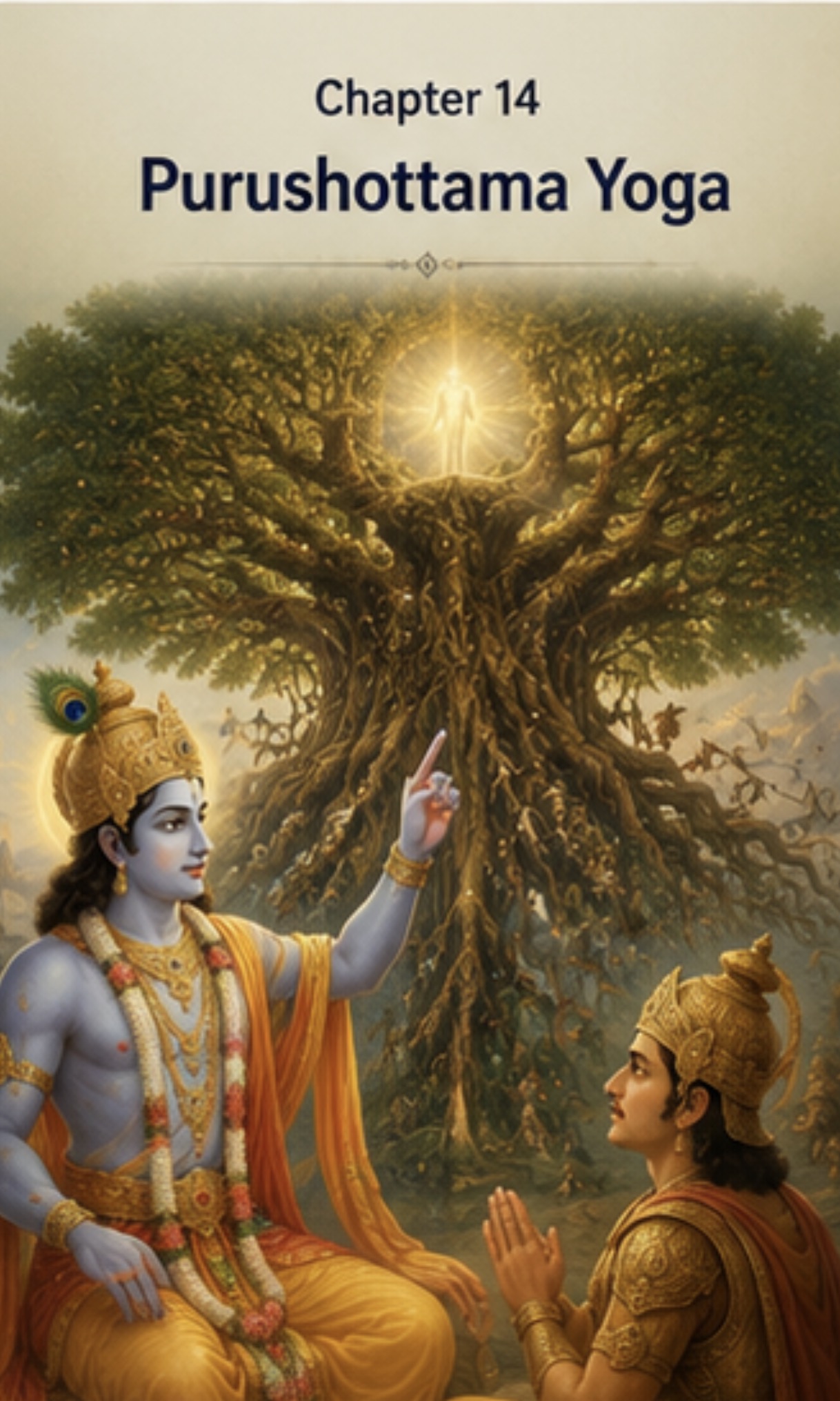
Purushottama Yoga describes the Supreme Divine Personality beyond the temporary material world. Lord Krishna explains the symbolic eternal tree of life whose roots are above and branches below, representing worldly attachment and illusion. He teaches that the soul is eternal and part of the Supreme Divine Consciousness. Krishna explains the difference between the perishable world, the imperishable soul, and the Supreme Lord who transcends both. This chapter guides seekers toward spiritual liberation by detaching from illusion and surrendering to the Supreme Truth.
0/2
Devasura Sampad Vibhaga Yoga
This chapter explains the difference between divine qualities (Daivi Sampad) and demonic qualities (Asuri Sampad). Lord Krishna describes virtues such as fearlessness, truthfulness, compassion, self-control, purity, humility, and spiritual discipline as divine qualities leading toward liberation and peace. In contrast, anger, pride, greed, ego, violence, hatred, and ignorance are described as demonic tendencies that lead to suffering and destruction. Krishna encourages spiritual seekers to cultivate noble qualities and live a righteous, disciplined, and dharmic life.
0/2
Shraddhatraya Vibahga Yoga
In this chapter, Lord Krishna explains the three types of faith based on the influence of Sattva, Rajas, and Tamas. A person’s faith shapes their thoughts, worship, food habits, discipline, charity, and spiritual practices. Sattvic faith leads toward purity, wisdom, balance, and spiritual growth. Rajasic faith is driven by ambition, ego, and material desires, while Tamasic faith is associated with ignorance, laziness, and harmful actions. Krishna teaches the importance of pure intention, disciplined living, truthful speech, and selfless spiritual practice.
0/2
Moksha Sanyas Yoga
The final chapter of the Bhagavad Gita summarizes all spiritual teachings given by Lord Krishna. Moksha Sannyasa Yoga explains renunciation, duty, selfless action, devotion, wisdom, meditation, and liberation. Krishna teaches Arjuna the importance of performing one’s dharma without attachment to results while surrendering fully to the Divine Will. The chapter emphasizes spiritual freedom from ego, desires, fear, and ignorance. In the end, Arjuna attains clarity, courage, and spiritual understanding, ready to fulfill his duty with faith and wisdom. This chapter concludes the Bhagavad Gita with the ultimate message of surrender, devotion, and liberation through divine knowledge.
0/2
Bhagavad Gita Complete Course

Purushottama Yoga, the Yoga of the Supreme Divine Personality, explains the eternal relationship between the soul, the material world, and the Supreme Lord. In this chapter, Lord Krishna reveals Himself as the Purushottama — the Supreme Divine Being who exists beyond both the temporary material world and the eternal soul.

Krishna describes the symbolic upside-down Ashvattha tree whose roots are above and branches below, representing worldly attachment, illusion, desires, and the cycle of material existence. He teaches that spiritual seekers must cut this tree of attachment with the weapon of detachment and seek the eternal Supreme Truth.

The chapter explains that every living being is an eternal part of the Divine, but due to ignorance and attachment, the soul becomes trapped in worldly suffering and illusion. Through devotion, wisdom, self-realization, and surrender to the Supreme Divine, one can attain liberation and eternal spiritual peace.

Students will learn:

• Meaning of Purushottama (Supreme Divine Personality)

• Symbolism of the Ashvattha tree

• Difference between soul, material nature, and Supreme Divine

• Importance of detachment from worldly illusion

• Relationship between the soul and God

• Spiritual liberation through devotion and wisdom

• Eternal nature of consciousness and Divine reality

• Path toward self-realization and Moksha

Purushottama Yoga guides seekers toward understanding the Supreme Divine Reality and inspires spiritual awakening, devotion, inner wisdom, and liberation from material attachment and ignorance.