Course Content
Module 1 — Introduction to Shanti Parva
This module introduces the background of Shanti Parva, the aftermath of the Kurukshetra war, and the timeless wisdom taught by Bhishma to Yudhishthira. Students will understand the importance of Dharma, inner peace, and spiritual wisdom in modern life.
0/3
Lesson 2 — Bhishma on the Bed of Arrows
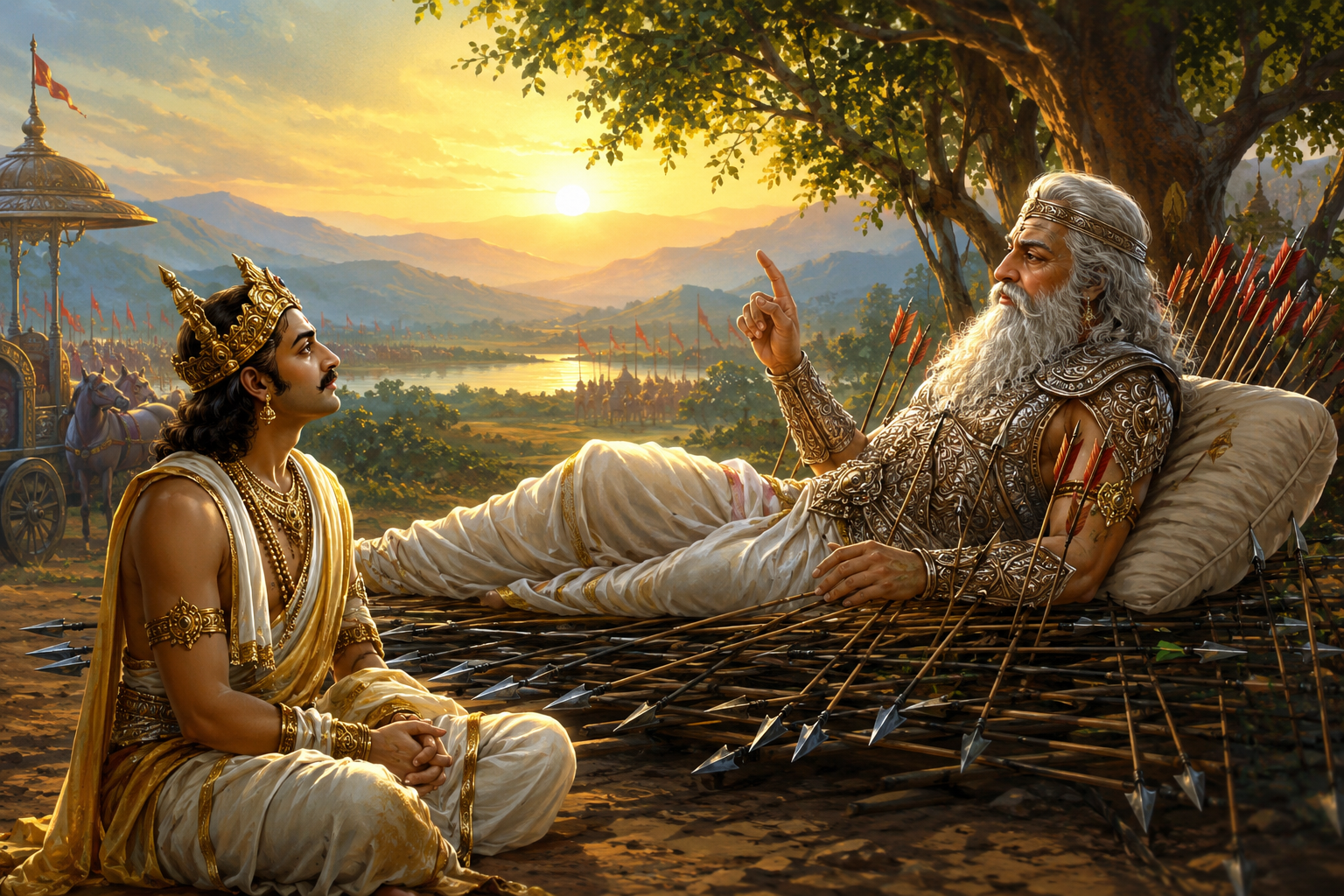
This lesson explains the final moments of Bhishma Pitamah after the Kurukshetra war and why his teachings became one of the greatest sources of spiritual and ethical wisdom in Indian philosophy. After the Kurukshetra war, Bhishma Pitamah lay on a bed of arrows, waiting for the sacred time of Uttarayana to leave his body. Although severely wounded, he remained calm, peaceful, and spiritually aware. King Yudhishthira was deeply disturbed by the destruction caused by the war. He felt guilt, confusion, and sadness despite becoming king. At that moment, Lord Krishna advised Yudhishthira to approach Bhishma for guidance. Bhishma then began teaching Dharma, leadership, truth, self-control, peace, compassion, and spiritual wisdom. These teachings later became known as Shanti Parva. Bhishma explained that true leadership is not based on power alone, but on wisdom, patience, ethics, and compassion. He also taught that inner peace is more valuable than material success. Modern Life Reflection: Even today, many people achieve success but still feel stress and emptiness. Shanti Parva teaches that peace of mind and moral wisdom are essential for a meaningful life. Daily Reflection: Ask yourself: “What qualities make a truly wise and peaceful person?”
0/1
Yudhishithira”s First Question to Bhishma
Yudhishthira’s First Question to Bhishma Yudhishthira’s Question After the terrible Kurukshetra war, King Yudhishthira approached Bhishma with deep sorrow and confusion. He bowed respectfully and asked: “How can a human being attain peace after witnessing suffering, loss, conflict, and pain?” Yudhishthira continued: “Even after winning the kingdom, my heart is restless. Why does victory not bring peace?” Bhishma’s Answer Bhishma smiled peacefully and replied: “Peace does not come from outer success or victory. Peace comes from mastery over the mind.” He explained: * A person may conquer kingdoms, * gain wealth, * achieve fame, yet still remain unhappy if: * anger controls the mind, * desires remain endless, * ego dominates thoughts, * and attachment creates fear. Bhishma said: “The uncontrolled mind itself becomes the greatest battlefield.” Story Related to Bhishma’s Teaching The King and the Golden Palace Once there was a king who built the most magnificent golden palace in the world. He believed: “When this palace is complete, I will finally become happy.” Years passed. The palace became more beautiful than anything people had ever seen. But after entering the palace, the king still felt: * anxiety, * fear, * stress, * and dissatisfaction. He could not sleep peacefully. Meeting the Sage One day, the king saw a simple sage meditating peacefully under a tree. The sage had: * no palace, * no servants, * no wealth. Yet his face radiated peace. The king asked: “How are you peaceful without luxury, while I remain unhappy despite having everything?” The sage replied: “Because your happiness depends on outer things. My peace depends on inner balance.” He explained: “A palace cannot remove fear, anger, greed, or attachment. Only wisdom and self-control can do that.” The king finally understood Bhishma’s teaching. Spiritual Meaning The palace represents: * external success, * material achievement, * worldly comfort. The sage represents: * inner awareness, * self-control, * detachment, * spiritual wisdom. Bhishma teaches that: external comfort without inner balance cannot create lasting peace. Current World Scenario Today many people: * achieve success, * buy expensive homes, * gain social media popularity, * earn money, yet still suffer from: * stress, * depression, * anxiety, * loneliness, * emotional emptiness. Why? Because: * the mind remains restless, * desires never end, * comparison continues, * inner peace is missing. Implementation in Modern Life Bhishma’s wisdom can be practiced today through: ✅ Self-control Pause before reacting emotionally. ✅ Gratitude Appreciate what already exists in life. ✅ Limiting comparison Avoid constant comparison with others. ✅ Mental discipline Practice meditation and silence daily. ✅ Ethical living Truthful and compassionate living reduces mental conflict. How to Use This Teaching in Difficult Situations Whenever you feel: * stressed, * angry, * jealous, * emotionally disturbed, ask yourself: “Is this problem outside me, or is my uncontrolled mind increasing the suffering?” This question itself begins inner healing. Practical Example Workplace Situation Suppose: * someone insults you in office, * or criticizes your work publicly. Immediate reaction: * anger, * ego, * emotional pain. Bhishma’s teaching says: first control the mind, remain calm, observe the situation wisely, then respond peacefully. This prevents: * conflict, * regret, * mental disturbance. Reflection Practice Sit quietly for 5 minutes. Ask yourself: “What truly gives me peace?” * money? * power? * praise? * inner balance? * wisdom? * meaningful relationships? Observe your thoughts honestly. Final Teaching of Bhishma Bhishma concluded: “The person who conquers the mind attains peace even in difficult circumstances. The person controlled by the mind remains restless even in luxury.” This became one of the foundational teachings of Shanti Parva.
Yudhishthira’s Second Question to Bhishma
Yudhishthira’s Second Question to Bhishma After listening to Bhishma’s first teaching about peace and the restless mind, Yudhishthira remained thoughtful and silent for some time. The evening sun slowly disappeared over the battlefield of Kurukshetra. The air was calm. Warriors, sages, and kings sat quietly around Bhishma. Then Yudhishthira folded his hands and asked another question. Yudhishthira Asked “Grandfather, what is the greatest Dharma for a human being?” He continued softly: “People perform rituals, prayers, sacrifices, and religious duties. But what is the highest Dharma that truly purifies the heart and brings peace?” Everyone present became silent, waiting for Bhishma’s answer. Bhishma Replied Bhishma looked compassionately at Yudhishthira and said: “Compassion toward all living beings is the highest Dharma.” He explained: “A person who causes unnecessary suffering to others can never attain true peace, even if he performs thousands of rituals.” Bhishma then narrated a story. The Story of the Dove, the Hunter, and the Compassionate Sage Long ago, deep within a dense forest filled with tall sal trees and flowing rivers, there lived a wise sage named Rishi Dayananda. The sage spent his days: * meditating, * teaching travelers, * helping injured animals, * and living peacefully in harmony with nature. Near his small hut, birds sang fearlessly because no creature was ever harmed there. The Stormy Night One evening dark clouds covered the sky. Thunder roared across the forest. Heavy rain began falling violently. Animals rushed toward shelter. At that moment, a frightened dove flew desperately through the storm. Its wings trembled with fear. Behind it came a hunter carrying a bow and arrows. The exhausted dove entered the sage’s hut and hid near his feet. Moments later, the hunter arrived at the door, soaked from the rain. He said angrily: “Revered sage, that dove is my prey. Return it to me.” The Sage’s Dilemma The sage now faced a difficult situation. If he protected the dove: * the hungry hunter might suffer. If he handed over the dove: * the innocent creature would die. The sage closed his eyes quietly for a moment. Then he welcomed the hunter respectfully inside the hut. He lit a small fire to warm him and offered fruits and food. The hunter was surprised. He asked: “Why are you serving me kindly when I came here with anger?” The sage replied peacefully: “Because hunger and suffering disturb the mind. A disturbed mind cannot understand compassion.” The Transformation As the storm continued outside, the hunter watched the sage carefully. He saw: * the dove resting safely, * the sage sharing his simple meal, * and the calmness inside the hut. Slowly the hunter’s anger disappeared. For the first time in many years, his heart softened. He lowered his bow and said: “Today I understand. Taking life blindly has hardened my heart.” He released the dove completely. The little bird flew into the rainy sky peacefully. Bhishma’s Teaching Bhishma explained to Yudhishthira: “True Dharma is not only rituals and rules. True Dharma is that which reduces suffering and awakens compassion.” He said: * compassion purifies the heart, * kindness calms the mind, * and cruelty creates inner darkness. Current World Scenario Today people often: * insult others online, * speak harshly, * exploit weak people, * harm animals, * destroy nature for greed, * and become emotionally insensitive. Despite technological progress: * stress increases, * loneliness increases, * anger increases. Why? Because compassion is decreasing. Shanti Parva teaches: humanity without compassion becomes spiritually empty. Practical Application in Daily Life Bhishma’s teaching can be practiced through small daily actions: ✅ speaking gently ✅ helping someone silently ✅ feeding animals ✅ listening patiently ✅ avoiding unnecessary anger ✅ respecting nature ✅ understanding others before judging them Even small kindness changes the mind. Reflection Practice Tonight sit silently for 5 minutes and ask yourself: “Did my words and actions today reduce suffering or increase it?” Observe honestly without guilt or judgment. Bhishma’s Final Teaching Bhishma concluded: “The person whose heart is filled with compassion comes naturally closer to Dharma, peace, and spiritual wisdom.” And the entire assembly remained silent, deeply moved by his word.
Yudhishthira’s Third Question to Bhishma
Yudhishthira’s Third Question to Bhishma The night grew deeper over the silent battlefield of Kurukshetra. A cool wind moved across the broken chariots and fallen weapons. Around Bhishma sat: * sages, * warriors, * kings, * and the Pandavas, listening carefully to every word spoken by the great grandsire. After hearing about compassion and Dharma, Yudhishthira folded his hands once again and asked: Yudhishthira Asked “Grandfather, why do human beings continue to suffer even after gaining wealth, comfort, and success?” He continued: “People spend their lives chasing happiness through possessions, power, and desires. Yet most remain anxious and dissatisfied. Why does this happen?” The entire assembly became silent. Bhishma closed his eyes for a moment and then began speaking slowly. Bhishma Replied “Because desire has no end. The more a person feeds uncontrolled desires, the more restless the mind becomes.” He explained: “Desire is like fire. Adding fuel does not extinguish it — it only makes the flames grow larger.” Bhishma then narrated an ancient story. The Story of the Thirsty King Long ago there lived a powerful king named Maharaj Somitra. His kingdom was prosperous beyond imagination. He possessed: * magnificent palaces, * countless horses and elephants, * precious jewels, * dancing halls, * gardens filled with rare flowers, * and treasure rooms overflowing with gold. People across neighboring kingdoms admired his success. But despite all this, Somitra remained deeply unhappy. Every morning he desired something new: * more land, * more power, * greater fame, * larger armies, * and richer treasures. Even while eating luxurious meals, his mind remained disturbed. At night he could not sleep peacefully. Fear constantly troubled him: * fear of losing wealth, * fear of enemies, * fear of becoming weaker than other kings. The Strange Encounter One summer afternoon, while hunting in a forest near the mountains, the king became separated from his soldiers. Exhausted and thirsty, he wandered alone until he reached a small lake surrounded by trees. Near the lake sat an old sage in deep meditation. The sage wore simple white cloth and lived inside a tiny hut made from bamboo and leaves. Despite having almost nothing, his face radiated extraordinary peace. The king felt surprised. The King’s Question After drinking water from the lake, the king asked: “Holy sage, I rule vast lands and possess endless wealth, yet my mind remains restless. You live with almost nothing, but you seem completely peaceful. What is the secret of your happiness?” The sage smiled gently. He pointed toward the lake and asked: “Can a thirsty man satisfy his thirst by drinking salty ocean water?” The king replied: “No. Salt water only increases thirst.” The sage nodded. “Uncontrolled desires are like salt water. The more the mind drinks from them, the greater its thirst becomes.” The Sage’s Wisdom The sage continued: “Wealth itself is not evil. Power itself is not evil. But attachment and endless craving create suffering.” He explained: * when desires control the mind, * peace disappears, * gratitude disappears, * simplicity disappears. The king sat silently beside the lake as the evening sun reflected upon the water. For the first time in many years, he realized that his suffering did not come from lack of wealth — it came from lack of contentment. Transformation of the King The king stayed with the sage for several days. During that time: * he ate simple food, * listened to birds, * watched the sunrise peacefully, * and experienced silence without luxury. Gradually his mind became lighter. When he returned to the palace: * he reduced unnecessary greed, * helped poor families, * stopped comparing himself with other rulers, * and practiced gratitude daily. Though he remained a king, his heart slowly became peaceful. Bhishma’s Teaching Bhishma explained to Yudhishthira: “Desire itself is not the problem. Slavery to endless desire creates suffering.” He taught: * controlled desires create balance, * uncontrolled desires create bondage. Current World Scenario Today many people constantly chase: * money, * luxury, * social media validation, * popularity, * status, * and endless consumption. Even after achieving success, many still experience: * stress, * anxiety, * depression, * emotional emptiness, * and dissatisfaction. Why? Because modern society continuously stimulates desire but rarely teaches contentment. Shanti Parva teaches: peace comes not from having everything, but from learning when enough is enough. Practical Application in Daily Life Bhishma’s wisdom can be practiced through: ✅ reducing unnecessary comparison ✅ limiting excessive material obsession ✅ practicing gratitude daily ✅ spending time in silence and nature ✅ simplifying lifestyle ✅ controlling impulsive desires ✅ appreciating present blessings Reflection Practice Tonight before sleeping, ask yourself honestly: “Which desires in my life are creating unnecessary restlessness?” Observe peacefully without judgment. Bhishma’s Final Teaching Bhishma concluded: “The person who learns contentment becomes rich even with little. The person controlled by endless desire remains poor even with great wealth.” And the sages sitting nearby silently nodded in agreement
Yudhishthira’s Fourth Question to Bhishma
The cool night wind moved softly across the battlefield of Kurukshetra. Torches burned quietly around the great assembly. The Pandavas, sages, kings, and warriors continued listening to the wisdom flowing from Bhishma. After hearing about anger and the restless nature of desire, Yudhishthira once again folded his hands respectfully and asked: Yudhishthira Asked “Grandfather, what is the true duty of a leader or ruler?” He continued thoughtfully: “Many rulers gain power through strength and fear. But what qualities make a leader truly respected, wise, and righteous?” Bhishma looked at Yudhishthira compassionately and replied slowly. Bhishma Replied “A true ruler does not rule for personal pleasure. A true ruler protects, serves, and uplifts society.” Bhishma explained: “Power without wisdom becomes dangerous. Leadership without compassion becomes oppression.” He then narrated an ancient story. The Story of the Two Kings Long ago, there were two neighboring kingdoms. One kingdom was ruled by King Adhiraj. The other by King Dharmaveer. Both kingdoms were wealthy and powerful. But the nature of the two rulers was completely different. King Adhiraj — The Fearful Ruler King Adhiraj believed: “Fear is the strongest way to control people.” He imposed: * heavy taxes, * harsh punishments, * strict laws, * and cruel treatment upon his citizens. His ministers feared speaking honestly. Servants trembled before him. People obeyed him outwardly, but secretly hated him. Even within the palace: * suspicion, * fear, * and tension filled the atmosphere. Though Adhiraj possessed power, he trusted nobody. At night he slept poorly, always fearing rebellion and betrayal. King Dharmaveer — The Wise Ruler In the neighboring kingdom, King Dharmaveer ruled very differently. He believed: “A king is the guardian of his people, not their owner.” He: * listened patiently to citizens, * reduced unnecessary suffering, * treated even poor people respectfully, * and made decisions based upon Dharma. When disputes arose, he sought: * justice, * compassion, * and truth together. Farmers, merchants, soldiers, and sages all respected him deeply. People obeyed him not from fear — but from love and trust. The Great Drought One year a severe drought struck both kingdoms. Rivers dried. Crops failed. Food became scarce. In King Adhiraj’s kingdom: * panic spread, * food was hoarded, * corruption increased, * and people began stealing to survive. The king became even harsher. He ordered severe punishments for anyone caught stealing food. Fear increased, but peace disappeared completely. Dharmaveer’s Response Meanwhile, King Dharmaveer gathered his ministers and said: “This is not the time for cruelty. This is the time for responsibility and compassion.” He: * opened royal food stores, * reduced taxes, * arranged water distribution, * and personally visited suffering villages. Seeing the king’s sincerity, wealthy citizens also began helping the poor. Gradually: * unity increased, * trust increased, * and society remained peaceful despite hardship. The Final Outcome Years later, travelers remembered the two kings very differently. People spoke of Adhiraj with fear and bitterness. But they remembered Dharmaveer with respect and gratitude long after his death. His kingdom remained stable because it was built upon: * trust, * Dharma, * compassion, * and wisdom. Bhishma’s Teaching Bhishma explained to Yudhishthira: “A ruler’s greatest strength is not fear — it is trust.” He taught: * leadership means service, * power must protect society, * and true authority comes from wisdom and character. Bhishma said: “The happiness of the people is the true success of a ruler.” Current World Scenario Today leadership exists everywhere: * governments, * companies, * schools, * families, * organizations, * and even social media influence. Some leaders: * control through fear, * ego, * anger, * or manipulation. Others lead through: * honesty, * calmness, * fairness, * empathy, * and wisdom. Shanti Parva teaches: leadership is not domination, leadership is responsibility. Practical Application in Daily Life Even ordinary people can practice Dharmic leadership by: ✅ listening patiently ✅ avoiding misuse of authority ✅ helping weaker people ✅ remaining fair during conflict ✅ speaking truthfully ✅ acting responsibly ✅ protecting rather than exploiting others Reflection Practices Tonight ask yourself quietly: “Do people feel fear around me, or trust around me?” Observe honestly. Bhishma’s Final Teaching Bhishma concluded: “The ruler who serves Dharma becomes loved by society. The ruler controlled by ego eventually destroys himself.” And the assembly sat silently, absorbing the depth of his wisdom.
Yudhishthira’s Fifth Question to Bhishma
Yudhishthira’s Fifth Question to Bhishma The sacred conversation between Yudhishthira and Bhishma continued through the silent nights of Kurukshetra. The moon shone softly above the battlefield. Even the warriors and sages sitting nearby felt that these teachings were not only for kings — but for all humanity. After reflecting deeply upon leadership, Dharma, and peace, Yudhishthira asked another important question. Yudhishthira Asked “Grandfather, what is the greatest enemy of human beings?” He continued thoughtfully: “People fear external enemies, wars, and dangers. But what truly destroys a person from within?” Bhishma looked toward the night sky and replied calmly. Bhishma Replied “The greatest enemy of a human being is uncontrolled greed.” He explained: “Greed slowly blinds wisdom, destroys contentment, weakens Dharma, and fills the mind with endless dissatisfaction.” Bhishma then narrated a story. The Story of the Greedy Landlord Long ago, in a fertile village near a beautiful river, there lived a wealthy landlord named Suryapal. He owned: * large farms, * many cattle, * grain stores, * servants, * and gold hidden in underground chambers. People believed he possessed more wealth than anyone else in the region. But despite his riches, Suryapal was never satisfied. Whenever he saw someone successful, jealousy entered his mind. If another farmer harvested good crops, he became restless. If merchants earned profit, he wanted even more. His greed continued growing every year. The Poor Farmer In the same village lived a poor farmer named Haridas. Haridas possessed: * a small piece of land, * two oxen, * a tiny hut, * and very little money. Yet he remained peaceful. Every evening: * he prayed, * shared food with travelers, * cared for animals, * and spent time with his family happily. Even during difficulties, he rarely complained. The Landlord’s Curiosity One day Suryapal became curious. He could not understand how a poor man remained peaceful while he himself remained anxious despite enormous wealth. So he visited Haridas secretly one evening. He found the farmer sitting peacefully outside his hut, watching the sunset with his children. The family was eating simple bread and vegetables together while smiling joyfully. Suryapal felt shocked. The Conversation The landlord asked: “Haridas, how can you remain happy with so little?” Haridas smiled gently and replied: “Because I try to enjoy what I already have instead of constantly suffering for what I do not have.” The landlord laughed. “But if you desired more, you could become rich like me.” Haridas answered peacefully: “Richness of possessions and richness of mind are not always the same.” These words disturbed Suryapal deeply. The Night of Fear That same night thieves attempted to enter Suryapal’s mansion. Though nothing was stolen, the landlord became terrified. He spent the entire night: * checking his treasure rooms, * guarding his gold, * suspecting servants, * and worrying endlessly. Meanwhile, Haridas slept peacefully inside his small hut. For the first time, Suryapal realized: his wealth was not giving him peace — it was increasing his fear. The Wise Sage A few days later, an old traveling sage entered the village. Suryapal approached him and asked: “Why does my wealth not satisfy me?” The sage picked up a handful of salty water from the sea and said: “The more salt water a thirsty man drinks, the greater his thirst becomes.” Then the sage explained: “Greed works in the same way. It promises satisfaction but creates endless craving.” The landlord became silent. Transformation Gradually Suryapal began changing his life. He: * helped poor villagers, * stopped exploiting farmers, * reduced unnecessary hoarding, * and practiced gratitude daily. Slowly his fear decreased. For the first time in many years, he began experiencing peace. Bhishma’s Teaching Bhishma explained to Yudhishthira: “Greed creates endless hunger within the mind. Contentment is the true wealth of life.” He taught: * greed destroys peace, * greed weakens compassion, * greed blinds judgment, * and greed creates suffering. Current World Scenario Today modern society constantly encourages: * endless consumption, * luxury obsession, * comparison, * social media competition, * and material pressure. People often think: “Just one more success, one more purchase, one more achievement will make me happy.” But the mind remains restless. As greed increases: * stress increases, * peace decreases, * relationships weaken, * and anxiety grows. Shanti Parva teaches: the richest person is not the one who owns the most, but the one who needs the least to remain peaceful. Practical Application in Daily Life Bhishma’s wisdom can be practiced by: ✅ practicing gratitude daily ✅ avoiding unnecessary comparison ✅ simplifying lifestyle ✅ helping others ✅ controlling impulsive desires ✅ appreciating small joys ✅ focusing on inner growth instead of endless accumulation Reflection Practice Tonight ask yourself quietly: “Which desires in my life are creating unnecessary fear or restlessness?” Observe honestly and peacefully. Bhishma’s Final Teaching Bhishma concluded: “A greedy mind remains poor even inside a palace. A content mind remains rich even inside a small hut.” And the entire assembly reflected deeply upon his wisdom
Yudhishthira’s Sixth Question to Bhishma
Yudhishthira’s Sixth Question to Bhishma The sacred teachings of Bhishma continued beneath the peaceful night sky of Kurukshetra. The battlefield that had once echoed with: * war cries, * clashing weapons, * and roaring conch shells had now become a place of deep spiritual wisdom. The Pandavas, sages, and kings listened silently as Bhishma continued guiding humanity through Dharma. After hearing about greed and contentment, Yudhishthira asked another important question. Yudhishthira Asked “Grandfather, why do human beings fear death so deeply?” He continued: “No one can escape death, yet people spend their entire lives fearing loss, old age, and the end of life. How can a person live peacefully without fear of death?” The atmosphere became deeply silent. Bhishma looked peacefully toward the stars and began speaking slowly. Bhishma Replied “Death itself is not the greatest cause of suffering. Ignorance about the true nature of life creates fear.” He explained: “The body is temporary, but the soul continues its journey.” Bhishma then narrated an ancient story. The Story of the Old Banyan Tree Long ago, near the banks of a sacred river, there stood a gigantic banyan tree. For hundreds of years: * birds built nests upon its branches, * travelers rested beneath its shade, * sages meditated near its roots, * and children played around it happily. The tree had witnessed: * changing seasons, * kings rising and falling, * floods, * storms, * and countless generations passing by. Yet the banyan tree stood peacefully through all changes. The Young Sapling Nearby grew a young sapling. The small tree often worried whenever storms arrived. It feared: * strong winds, * falling leaves, * darkness, * and destruction. One evening during the rainy season, the frightened sapling asked the old banyan tree: “How do you remain so calm despite witnessing so many storms and changes?” The banyan tree replied gently: “Because I have understood the law of nature.” The Banyan Tree’s Wisdom The old tree continued: “Every leaf that grows upon me eventually falls. Every season changes. Every storm eventually passes.” It explained: “Fear comes when we try to hold permanently what is temporary.” The sapling listened carefully. The banyan tree then said: “Life flows continuously. Birth and death are part of nature’s rhythm, just as sunrise and sunset are part of every day.” The Great Storm One night a powerful storm struck the forest. Thunder shook the sky. Strong winds blew violently. The young sapling trembled with fear. Many branches of the old banyan tree broke and fell. But even during the storm, the ancient tree remained calm. When morning arrived, the sapling asked: “Were you not afraid?” The banyan tree replied peacefully: “Why should I fear what is part of nature? Change is unavoidable. Fear only increases suffering.” Spiritual Meaning Bhishma explained to Yudhishthira: The banyan tree represents: * wisdom, * acceptance, * spiritual understanding. The fearful sapling represents: * attachment, * ignorance, * and fear of impermanence. Bhishma taught: “The person who understands the temporary nature of life becomes peaceful.” Bhishma’s Teaching About Death Bhishma said: * death is certain for every body, * but fear reduces when the mind becomes wise, * peaceful, * and spiritually aware. He explained: “A meaningful life removes fear more than endless attachment.” The person who lives with: * truth, * compassion, * Dharma, * and self-awareness gradually becomes less afraid of death. Current World Scenario Today many people fear: * aging, * illness, * financial loss, * uncertainty, * and death itself. Because modern society focuses heavily on: * external success, * physical beauty, * possessions, * and attachment, people become mentally disturbed whenever change appears. Even small losses create anxiety. Shanti Parva teaches: peace comes from accepting the changing nature of life. Practical Application in Daily Life Bhishma’s wisdom can be practiced through: ✅ accepting change peacefully ✅ spending time in spiritual reflection ✅ reducing unhealthy attachment ✅ valuing relationships over possessions ✅ living ethically and meaningfully ✅ practicing meditation and silence ✅ appreciating each day with gratitude Reflection Practice Tonight sit quietly for a few minutes and ask yourself: “Am I truly living meaningfully, or only worrying constantly about the future?” Observe gently without fear. Bhishma’s Final Teaching Bhishma concluded: “The person who understands life deeply stops fearing death excessively. Such a person learns to live peacefully, wisely, and fully.” And the sacred silence of Kurukshetra became even deeper after his words.
Yudhishthira’s Seventh Question to Bhishma
Yudhishthira’s Seventh Question to Bhishma The sacred discussions between Yudhishthira and Bhishma continued as the stars shone silently above Kurukshetra. The battlefield that had once witnessed destruction had now become a place of wisdom and spiritual awakening. Sages sat quietly around Bhishma, listening to every word with deep attention. After hearing about death, impermanence, and peace, Yudhishthira once again bowed respectfully and asked: Yudhishthira Asked “Grandfather, what is true happiness?” He continued thoughtfully: “People spend their entire lives searching for happiness through wealth, relationships, success, comfort, and achievements. Yet very few seem truly peaceful and satisfied. What is the secret of genuine happiness?” Bhishma smiled gently and replied. Bhishma Replied “True happiness does not come from outer possessions alone. It arises from a peaceful and content mind.” He explained: “A disturbed mind cannot enjoy even the greatest luxury, while a peaceful mind can remain happy even with little.” Bhishma then narrated a story. The Story of the Rich Merchant and the Boatman Long ago, in a prosperous city beside a wide river, lived a wealthy merchant named Ratnadev. His mansion was enormous. Inside it were: * golden lamps, * silk curtains, * expensive perfumes, * servants, * and treasure chests filled with jewels. Every day traders from distant kingdoms visited him. People considered Ratnadev one of the richest men in the land. Yet despite his wealth, he remained constantly worried. His mind was always occupied with: * profits, * losses, * competition, * and fear of losing his riches. Even during festivals, his face rarely showed peace. At night he often stayed awake thinking about business and future uncertainties. The River Journey One morning Ratnadev needed to cross the river for trade. A simple old boatman carried him across in a small wooden boat. As the boat moved peacefully through the calm river, the merchant noticed something surprising. The old boatman appeared deeply joyful. He hummed songs softly while rowing. His face reflected calmness and contentment. Ratnadev became curious. The Merchant’s Question The merchant asked: “Boatman, how can you remain so cheerful with such a simple life?” The old man smiled and replied: “Why should I not be peaceful?” The merchant looked around the tiny boat and said: “You possess almost nothing. No mansion, no servants, no wealth. Yet you seem happier than many rich people.” The boatman laughed gently. ⸻ The Boatman’s Wisdom The boatman pointed toward the flowing river and said: “This river flows peacefully because it does not try to hold anything permanently.” Then he continued: “Most people suffer because they constantly chase more and fear losing what they already have.” The merchant listened silently. The boatman said: “I eat simple food, sleep peacefully, work honestly, and remain grateful for each day. Therefore my mind remains light.” He then asked the merchant: “Tell me honestly — does your wealth allow you peaceful sleep?” Ratnadev became silent. For the first time, he realized that despite enormous success, his mind remained exhausted. ⸻ 🌿 The Storm As they continued crossing the river, dark clouds suddenly gathered. Strong winds began shaking the small boat. The merchant became terrified. He shouted nervously: “Save me! Save me!” But the old boatman remained calm. He carefully controlled the boat while speaking peacefully. After some time, the storm passed safely. The merchant asked in amazement: “How did you remain calm during danger?” The boatman replied: “Fear reduces when the mind learns simplicity, acceptance, and trust.” Transformation of the Merchant After returning home, Ratnadev could not forget the old boatman’s words. Gradually he began changing his life. He: * reduced unnecessary greed, * spent more time with family, * helped poor people, * practiced gratitude, * and simplified many aspects of his life. Though he remained wealthy, his attachment slowly decreased. For the first time in years, he experienced peaceful sleep and genuine happiness. Bhishma’s Teaching Bhishma explained to Yudhishthira: “Happiness is not merely having more. Happiness is learning contentment, balance, gratitude, and inner peace.” He taught: * desires without control create suffering, * comparison destroys joy, * and simplicity often brings deeper peace than luxury. Current World Scenario Today many people believe happiness comes from: * expensive lifestyles, * social media popularity, * luxury, * constant entertainment, * and endless achievement. Yet modern society experiences: * stress, * loneliness, * anxiety, * emotional exhaustion, * and dissatisfaction. People constantly compare themselves with others and feel “not enough.” Shanti Parva teaches: true happiness comes from inner balance, not endless external accumulation. Practical Application in Daily Life Bhishma’s wisdom can be practiced through: ✅ gratitude daily ✅ spending time in silence and nature ✅ reducing comparison ✅ simplifying life ✅ meaningful relationships ✅ mindful living ✅ controlling unnecessary desires ✅ appreciating small joys Reflection Practice Tonight ask yourself quietly: “What truly makes my mind peaceful and happy?” Observe honestly without rushing. Bhishma’s Final Teaching Bhishma concluded: “The happiest person is not the one who owns the most, but the one whose mind remains peaceful with what life provides.” And the cool winds of Kurukshetra carried his wisdom into the silent Night.
Yudhishthira’s Eighth Question to Bhishma
Yudhishthira’s Eighth Question to Bhishma The sacred teachings of Bhishma continued beneath the vast sky of Kurukshetra. The battlefield had now transformed into a great school of wisdom. Kings, sages, warriors, and seekers sat silently around Bhishma, absorbing every word spoken by the grandsire. After hearing about happiness and contentment, Yudhishthira bowed respectfully once again and asked: Yudhishthira Asked “Grandfather, why do people become trapped in ego and pride?” He continued thoughtfully: “Even wise, wealthy, and powerful people sometimes fall because of arrogance. Why does ego blind human beings?” Bhishma closed his eyes gently for a moment and then replied. Bhishma Replied “Ego is one of the greatest illusions of the human mind.” He explained: “When a person forgets humility, gratitude, and Dharma, pride slowly blinds wisdom.” Bhishma then narrated an ancient story. The Story of the Proud Scholar Long ago, in a famous city known for learning and philosophy, lived a brilliant scholar named Acharya Varun. He possessed extraordinary knowledge of: * scriptures, * logic, * philosophy, * and sacred rituals. Kings invited him to royal courts. Students traveled from distant lands to study under him. People praised his intelligence everywhere. Over time, however, pride slowly entered his heart. Varun began believing: “There is nobody wiser than me.” He stopped listening patiently to others. He mocked simpler people and enjoyed defeating scholars during debates. Though people respected his knowledge, many feared his arrogance. The Old Saint One day news spread that a mysterious old saint had arrived near the river outside the city. People said: * the saint spoke very little, * lived simply, * but radiated extraordinary peace. Curious and somewhat irritated, Varun decided to meet him. He thought: “I will test whether this saint truly possesses wisdom.” The Meeting Varun arrived proudly at the saint’s small hut. The saint sat quietly beneath a tree, watching the flowing river peacefully. Varun spoke confidently: “I have mastered scriptures, philosophy, rituals, and debates. Tell me, holy man, what wisdom do you possess?” The saint smiled gently but said nothing. This irritated Varun. He repeated proudly: “Do you not know who I am?” The saint calmly replied: “Yes. I see a man carrying a very heavy burden.” Varun became confused. He looked around and said: “I carry nothing.” The saint pointed softly toward his chest and said: “You carry the burden of your own ego.” The Cup of Tea The saint invited Varun to sit. He began pouring tea into a cup. The cup became full. But the saint continued pouring. Tea overflowed onto the ground. Varun quickly said: “Stop! The cup is already full.” The saint smiled peacefully and replied: “Just like this overflowing cup, your mind is already filled with pride and self-importance. How can true wisdom enter?” The words struck Varun deeply. For the first time in years, he became silent. The Night of Reflection That evening Varun walked alone beside the river. He remembered: * how harshly he had treated others, * how desperately he sought praise, * and how pride had slowly removed peace from his heart. Though he possessed knowledge, he lacked humility. For the first time, tears entered his eyes. Transformation The next morning Varun returned to the saint and bowed sincerely. He said: “Today I understand that knowledge without humility becomes dangerous.” The saint blessed him gently and replied: “True wisdom makes a person humble, peaceful, and compassionate.” From that day onward: * Varun spoke more kindly, * listened patiently, * respected others, * and used his knowledge to help rather than dominate. People now loved him not only for his intelligence — but for his humility. Bhishma’s Teaching Bhishma explained to Yudhishthira: “Ego creates separation between human beings and truth.” He taught: * ego blinds judgment, * destroys relationships, * creates anger, * and increases suffering. But humility: * opens the heart, * deepens wisdom, * and brings peace. Current World Scenario Today ego appears everywhere: * social media pride, * constant need for validation, * arrogance of wealth, * intellectual superiority, * political ego, * and personal image obsession. People often seek: * praise, * attention, * followers, * and dominance. As ego increases: * peace decreases, * comparison increases, * and relationships become weaker. Shanti Parva teaches: true greatness is not loud pride, but quiet wisdom and humility. Practical Application in Daily Life Bhishma’s wisdom can be practiced through: ✅ listening more ✅ speaking humbly ✅ accepting mistakes ✅ reducing unnecessary comparison ✅ respecting all people equally ✅ practicing gratitude ✅ remembering the temporary nature of success Reflection Practice Tonight sit quietly and ask yourself: “Do I seek truth, or only praise and validation?” Observe peacefully without judgment. Bhishma’s Final Teaching Bhishma concluded: “The tree filled with fruits bends downward in humility. Similarly, a truly wise person naturally becomes humble.” And the cool night winds carried his words gently across Kurukshetra
Yudhishthira’s Ninth Question to Bhishma
Yudhishthira’s Ninth Question to Bhishma The sacred dialogue between Yudhishthira and Bhishma continued beneath the calm sky of Kurukshetra. The battlefield that once witnessed destruction had now become a place of profound wisdom and self-realization. The cool winds moved gently across the land while sages sat in complete silence around Bhishma. After hearing about ego and humility, Yudhishthira bowed respectfully once again and asked: Yudhishthira Asked “Grandfather, why does the human mind become restless so easily?” He continued thoughtfully: “Even when external problems are small, the mind creates worry, fear, anxiety, anger, and confusion. How can a person attain a stable and peaceful mind?” Bhishma looked compassionately at Yudhishthira and replied slowly. Bhishma Replied “The uncontrolled mind behaves like a restless monkey jumping endlessly from branch to branch.” He explained: “A mind without discipline becomes disturbed by desires, fears, comparisons, memories, and imagination.” Bhishma then narrated a story. The Story of the Lake and the Moon Long ago, high in the mountains near a peaceful forest, there existed a beautiful lake. Its water was so clear and calm that travelers could see the reflection of the moon shining perfectly upon its surface every night. Nearby lived an old sage who meditated beside the lake daily. Many students visited him seeking wisdom and peace. The Young Disciple Among his students was a young disciple named Anand. Anand was sincere and intelligent, but his mind remained extremely restless. Whenever he sat for meditation: * thoughts distracted him, * fears entered his mind, * memories disturbed him, * and worries about the future continued endlessly. One evening Anand approached the sage and said: “Master, I try to find peace, but my mind never becomes quiet. Why is it so difficult to control the mind?” The sage smiled gently and asked Anand to follow him to the lake. The Disturbed Water That night the moon was shining brightly above the mountains. The sage pointed toward the lake and asked: “What do you see?” Anand replied: “I see the beautiful reflection of the moon.” The sage then picked up a stick and stirred the water forcefully. The reflection immediately disappeared into distorted waves. The sage asked: “Can you see the moon clearly now?” Anand replied: “No, Master. The disturbed water cannot reflect the moon properly.” The sage smiled peacefully. The Sage’s Wisdom The sage explained: “The moon represents truth, wisdom, and inner peace.” He continued: “The lake represents the human mind.” Then he said softly: “When the mind becomes disturbed by fear, anger, greed, comparison, and endless thinking, it loses the ability to reflect truth clearly.” Anand listened silently. The sage then added: “Peace does not come by forcing the mind violently. Peace comes gradually through awareness, discipline, simplicity, and practice.” The Practice For many months Anand continued practicing under the sage’s guidance. Every morning: * he sat silently beside the lake, * observed his breathing, * reduced unnecessary speech, * spent time in nature, * and practiced gratitude. Slowly his thoughts became calmer. One night while meditating beside the still lake, Anand again saw the perfect reflection of the moon. At that moment he understood the sage’s teaching deeply. Transformation As Anand’s mind became calmer: * fear reduced, * anger weakened, * clarity increased, * and peace slowly entered his heart. He realized: the problem was not the world — the disturbance was inside the restless mind itself. Bhishma’s Teaching Bhishma explained to Yudhishthira: “A disturbed mind creates suffering even in comfortable situations. A peaceful mind remains balanced even during difficulty.” He taught: * discipline calms the mind, * simplicity reduces mental noise, * and self-awareness creates inner stability. Current World Scenario Today the human mind is constantly disturbed by: * social media overload, * comparison, * negative news, * excessive entertainment, * fear about the future, * financial pressure, * and nonstop thinking. Even while resting physically, many people remain mentally exhausted. As mental distraction increases: * anxiety increases, * sleep problems increase, * emotional instability increases. Shanti Parva teaches: peace begins when the mind becomes quieter and more aware. Practical Application in Daily Life Bhishma’s wisdom can be practiced through: ✅ daily silence for a few minutes ✅ meditation and breathing practices ✅ reducing excessive screen time ✅ spending time in nature ✅ avoiding unnecessary comparison ✅ simplifying thoughts and lifestyle ✅ practicing gratitude and awareness Reflection Practice Tonight sit silently for 5 minutes and simply observe your thoughts without fighting them. Then ask yourself: “What is disturbing my inner lake unnecessarily?” Observe peacefully. Bhishma’s Final Teaching Bhishma concluded: “The person who learns to calm the mind discovers peace everywhere. The person controlled by a restless mind remains disturbed even in paradise.” And the sages sitting nearby closed their eyes in deep contemplation after hearing these words.
Shanti Parva Course ” Ancient Indian Phycology & Wisdom”

Story — Bhishma’s Final Wisdom

After eighteen days of the terrible Kurukshetra war, the battlefield became silent.

Millions of warriors had died.

Families were destroyed.

The land was filled with grief and suffering.

Among the greatest warriors lying on the battlefield was Bhishma, the grandsire of the Kuru dynasty.

Because of a boon granted to him earlier in life, Bhishma could choose the time of his death. Therefore, although wounded by countless arrows, he remained alive on a bed of arrows, calmly waiting for the sacred period of Uttarayana.

 Yudhishthira’s Pain

King Yudhishthira had won the war, but his heart was filled with sorrow.

He thought:

  • “Was this victory worth so much destruction?”
  • “How can I rule a kingdom built upon suffering?”
  • “What is true Dharma?”

Even after gaining power, he felt no peace.

Seeing his mental suffering, Krishna told him:

“The wisest person still living is Bhishma.

Go and learn from him.”

The Journey to Bhishma

Yudhishthira, along with Krishna, the Pandavas, sages, and many kings, approached Bhishma respectfully.

Even while lying on arrows, Bhishma’s face remained peaceful.

There was no anger in him.

No hatred.

No bitterness.

This deeply surprised everyone.

Bhishma’s First Teaching

Yudhishthira bowed and asked:

“How can a person remain peaceful after witnessing so much suffering?”

Bhishma replied:

“Peace does not come from outer victory.

True peace comes from mastery over the mind, attachment, ego, and desires.”

He explained:

  • anger destroys wisdom,
  • greed destroys peace,
  • ego destroys relationships,
  • attachment creates suffering.

He taught that Dharma means:

  • truth,
  • compassion,
  • patience,
  • self-control,
  • and responsibility toward society.

 Spiritual Symbolism

Bhishma lying on arrows symbolizes:

 Human suffering

Even great people experience pain.

 Detachment

Despite pain, Bhishma remained mentally calm.

 Wisdom through experience

His teachings became powerful because they came after witnessing life, war, loss, and duty.

Modern Life Example

Today many people:

  • achieve career success,
  • earn money,
  • gain status,

yet still feel:

  • anxiety,
  • emptiness,
  • emotional stress.

Shanti Parva teaches:

External success alone cannot create inner peace.

A peaceful mind requires:

  • ethics,
  • balance,
  • wisdom,
  • gratitude,
  • and emotional discipline.

 Reflection Practice

Sit quietly for 3 minutes and reflect:

“What truly brings peace into my life?”

  • achievement?
  • power?
  • relationships?
  • inner balance?
  • spiritual understanding?

Lesson Conclusion

Bhishma’s teachings remind humanity that:

Real victory is not defeating others.

Real victory is conquering anger, ego, greed, and inner conflict.

This is the beginning of the wisdom of Shanti Parva.

This lesson explains the meaning, background, and spiritual importance of Shanti Parva in the Mahabharata. Students will learn why Bhishma’s teachings are considered timeless wisdom for humanity.