Upnishads
About Course
What are the Upanishads?
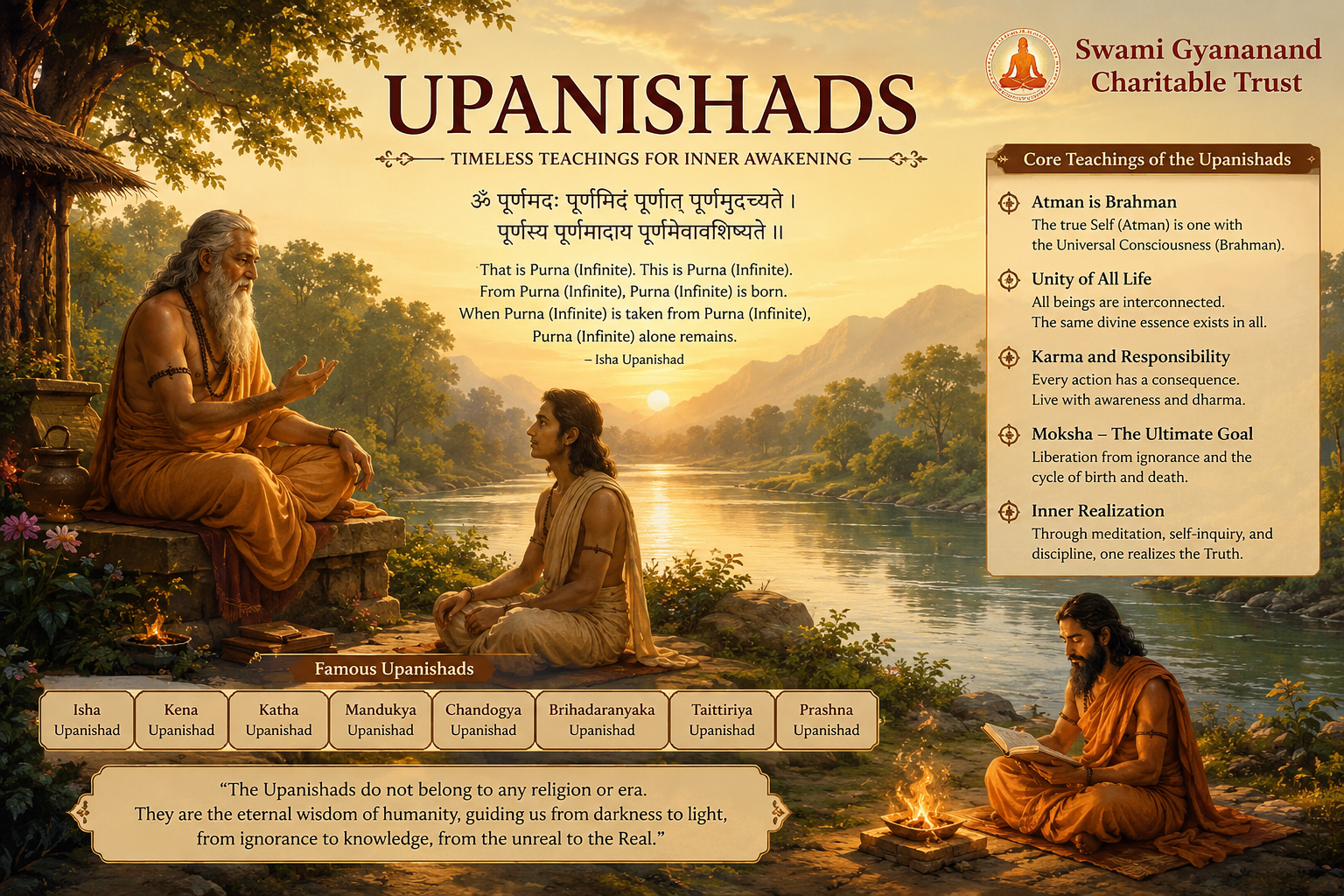
The Upanishads are among the most profound spiritual and philosophical texts of ancient India. They form the concluding part of the Vedas and are therefore also known as “Vedanta,” meaning “the end or highest knowledge of the Vedas.”
The word “Upanishad” comes from Sanskrit and means:
“Sitting near the teacher with devotion to receive spiritual wisdom.”
The Upanishads contain deep conversations between:
– sages,
– spiritual teachers,
– kings,
– seekers,
– and students
who explore the ultimate questions of life, consciousness, reality, and the nature of the soul.
Main Teachings of the Upanishads
The Upanishads focus on spiritual wisdom rather than rituals alone. They explore questions such as:
– Who am I?
– What is the true nature of the soul?
– What is consciousness?
– What is the purpose of life?
– What happens after death?
– What is ultimate reality?
– How can a human attain liberation and inner peace?
The central teaching of the Upanishads is that the true Self (Atman) is deeply connected with the universal consciousness (Brahman).
—
Core Philosophical Concepts
Atman (The Inner Self)
The eternal soul or true self beyond the physical body and mind.
Brahman (Universal Consciousness)
The infinite divine reality that exists within all beings and throughout the universe.
Karma
Every action creates consequences that influence human life.
Moksha
Liberation from ignorance, suffering, and the cycle of birth and death.
Meditation and Self-Realization
The Upanishads emphasize silence, contemplation, meditation, and self-awareness as paths toward inner awakening.
– Importance of the Upanishads
The Upanishads are considered some of the greatest works of spiritual philosophy in world history. Their teachings influenced:
– Vedanta philosophy,
– Yoga traditions,
– meditation practices,
– mindfulness teachings,
– and spiritual thought across the world.
Many modern ideas related to:
– consciousness,
– emotional balance,
– mindfulness,
– self-awareness,
– and inner peace
have deep roots in the wisdom of the Upanishads.
—
Famous Upanishads
Some of the most important Upanishads include:
– Isha Upanishad
– Kena Upanishad
– Katha Upanishad
– Mandukya Upanishad
– Chandogya Upanishad
– Brihadaranyaka Upanishad
– Taittiriya Upanishad
– Prashna Upanishad
Each Upanishad teaches spiritual wisdom through stories, dialogues, symbols, and philosophical insights.
– Why Study the Upanishads Today?
In today’s fast-paced world filled with:
– stress,
– anxiety,
– confusion,
– emotional imbalance,
– and constant distraction,
the Upanishads offer timeless guidance for:
– inner peace,
– clarity of mind,
– emotional healing,
– mindfulness,
– conscious living,
– and spiritual growth.
Their teachings help individuals move from fear and restlessness toward wisdom and self-awareness.
Teaching Style of the Upanishads
The Upanishads teach through:
– stories,
– symbolic examples,
– questions and answers,
– teacher-student dialogues,
– meditation insights,
– and practical spiritual wisdom.
This makes them deeply engaging, reflective, and transformative.
—
Modern Relevance
The Upanishads can be understood as:
– ancient spiritual psychology,
– consciousness studies,
– mindfulness philosophy,
– and practical wisdom for balanced living.
Their teachings remain highly relevant for:
– yoga students,
– meditation practitioners,
– wellness seekers,
– spiritual learners,
– and anyone searching for deeper meaning and peace in life.
—
Conclusion
The Upanishads are timeless spiritual treasures that guide humanity toward:
– self-realization,
– wisdom,
– peace,
– compassion,
– mindfulness,
– and liberation from inner suffering.
They teach that true happiness is not found outside, but within the awakened and peaceful self.
Course Content
The First Upanishad Teaching — Isha Upanishad
Student Ratings & Reviews