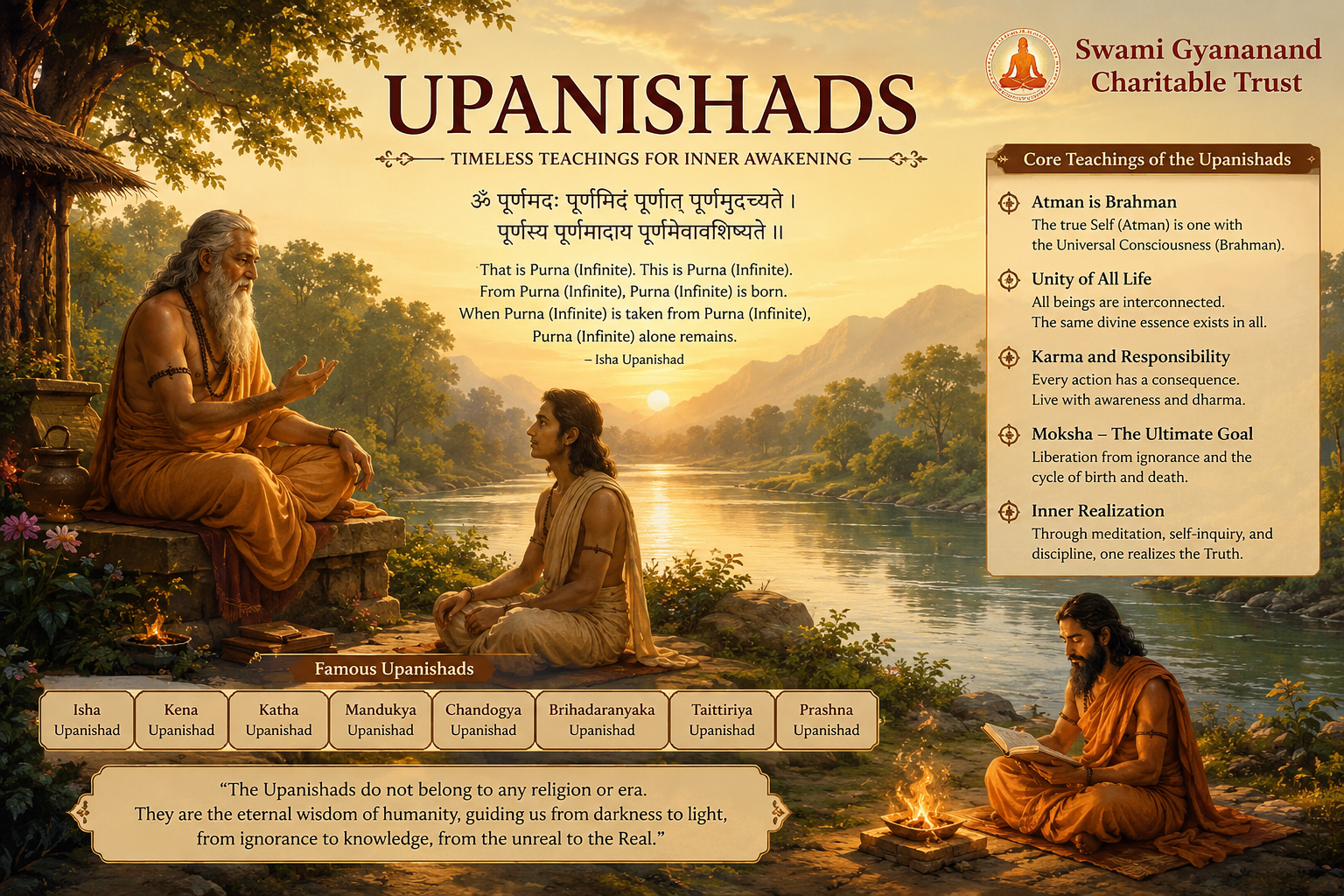
Upnishads

Categories: Upanishads
Wishlist Share

About Course

What are the Upanishads?

The Upanishads are among the most profound spiritual and philosophical texts of ancient India. They form the concluding part of the Vedas and are therefore also known as “Vedanta,” meaning “the end or highest knowledge of the Vedas.”

The word “Upanishad” comes from Sanskrit and means:

“Sitting near the teacher with devotion to receive spiritual wisdom.”

The Upanishads contain deep conversations between:

– sages,

– spiritual teachers,

– kings,

– seekers,

– and students

who explore the ultimate questions of life, consciousness, reality, and the nature of the soul.

 Main Teachings of the Upanishads

The Upanishads focus on spiritual wisdom rather than rituals alone. They explore questions such as:

– Who am I?

– What is the true nature of the soul?

– What is consciousness?

– What is the purpose of life?

– What happens after death?

– What is ultimate reality?

– How can a human attain liberation and inner peace?

The central teaching of the Upanishads is that the true Self (Atman) is deeply connected with the universal consciousness (Brahman).

 Core Philosophical Concepts

 Atman (The Inner Self)

The eternal soul or true self beyond the physical body and mind.

 Brahman (Universal Consciousness)

The infinite divine reality that exists within all beings and throughout the universe.

 Karma

Every action creates consequences that influence human life.

 Moksha

Liberation from ignorance, suffering, and the cycle of birth and death.

 Meditation and Self-Realization

The Upanishads emphasize silence, contemplation, meditation, and self-awareness as paths toward inner awakening.

– Importance of the Upanishads

The Upanishads are considered some of the greatest works of spiritual philosophy in world history. Their teachings influenced:

– Vedanta philosophy,

– Yoga traditions,

– meditation practices,

– mindfulness teachings,

– and spiritual thought across the world.

Many modern ideas related to:

– consciousness,

– emotional balance,

– mindfulness,

– self-awareness,

– and inner peace

have deep roots in the wisdom of the Upanishads.

 Famous Upanishads

Some of the most important Upanishads include:

– Isha Upanishad

– Kena Upanishad

– Katha Upanishad

– Mandukya Upanishad

– Chandogya Upanishad

– Brihadaranyaka Upanishad

– Taittiriya Upanishad

– Prashna Upanishad

Each Upanishad teaches spiritual wisdom through stories, dialogues, symbols, and philosophical insights.

– Why Study the Upanishads Today?

In today’s fast-paced world filled with:

– stress,

– anxiety,

– confusion,

– emotional imbalance,

– and constant distraction,

the Upanishads offer timeless guidance for:

– inner peace,

– clarity of mind,

– emotional healing,

– mindfulness,

– conscious living,

– and spiritual growth.

Their teachings help individuals move from fear and restlessness toward wisdom and self-awareness.

 Teaching Style of the Upanishads

The Upanishads teach through:

– stories,

– symbolic examples,

– questions and answers,

– teacher-student dialogues,

– meditation insights,

– and practical spiritual wisdom.

This makes them deeply engaging, reflective, and transformative.

 Modern Relevance

The Upanishads can be understood as:

– ancient spiritual psychology,

– consciousness studies,

– mindfulness philosophy,

– and practical wisdom for balanced living.

Their teachings remain highly relevant for:

– yoga students,

– meditation practitioners,

– wellness seekers,

– spiritual learners,

– and anyone searching for deeper meaning and peace in life.

 Conclusion

The Upanishads are timeless spiritual treasures that guide humanity toward:

– self-realization,

– wisdom,

– peace,

– compassion,

– mindfulness,

– and liberation from inner suffering.

They teach that true happiness is not found outside, but within the awakened and peaceful self.

Show More

What Will You Learn?

  • Why Study the Upanishads Today?
  • In today’s fast-paced world filled with:
  • - stress,
  • - anxiety,
  • - confusion,
  • - emotional imbalance,
  • - and constant distraction,
  • the Upanishads offer timeless guidance for:
  • - inner peace,
  • - clarity of mind,
  • - emotional healing,
  • - mindfulness,
  • - conscious living,
  • - and spiritual growth.
  • Their teachings help individuals move from fear and restlessness toward wisdom and self-awareness.
  • ---
  • Teaching Style of the Upanishads
  • The Upanishads teach through:
  • - stories,
  • - symbolic examples,
  • - questions and answers,
  • - teacher-student dialogues,
  • - meditation insights,
  • - and practical spiritual wisdom.

Course Content

The First Upanishad Teaching — Isha Upanishad
The First Upanishad Teaching — Isha Upanishad The Isha Upanishad is one of the most beautiful and profound Upanishads of ancient India. Though very short, it contains deep teachings about: * peace, * detachment, * contentment, * mindfulness, * and the true purpose of life. It teaches humanity how to live peacefully in the world without becoming trapped by greed, ego, and endless desires. The First Teaching of Isha Upanishad The famous opening teaching says: “Everything in this universe is filled with the Divine. Therefore enjoy life with gratitude and do not become greedy or excessively attached.” This teaching means: * nothing truly belongs to us permanently, * life is temporary, * possessions come and go, * but peace comes through balanced living and awareness. Story — The King and the Gardener Long ago there lived a powerful king named Veerendra. His palace was enormous. He possessed: * gold, * elephants, * armies, * beautiful gardens, * and treasures from distant kingdoms. Yet despite all his luxury, the king remained mentally disturbed. Every day he worried about: * protecting wealth, * losing power, * enemies, * and maintaining control. Even while sitting inside beautiful gardens, his mind remained restless. The Old Gardener Inside the royal garden worked an old gardener named Madhava. Madhava owned almost nothing: * a small hut, * simple clothes, * and basic food. Yet every morning he worked joyfully among flowers and trees. He sang peacefully while watering plants. The king often observed him secretly and became curious. One morning the king asked: “Madhava, how do you remain so peaceful despite living such a simple life?” The gardener smiled gently. The Gardener’s Wisdom The old gardener pointed toward the flowers and said: “Maharaj, every flower blooms beautifully and then fades away. Yet the garden remains peaceful because nature accepts change.” Then he continued: “We suffer because we try to possess everything permanently.” The king listened silently. The gardener explained: “I care for these flowers lovingly, but I do not become attached to owning them forever.” Then he softly said: “Enjoy what life gives, but do not become imprisoned by attachment.” These words deeply touched the king. Transformation of the King That evening the king walked alone through the garden. For the first time he noticed: * the fragrance of flowers, * cool winds, * birds singing, * and the beauty of the sunset. He realized: * his mind had become trapped in fear and greed, * while simple moments of life had been ignored. Gradually he changed: * he reduced unnecessary luxury, * became kinder, * spent time in silence, * and practiced gratitude daily. Though he remained king, his heart slowly became peaceful. Teaching of Isha Upanishad The Isha Upanishad teaches: Enjoy life with awareness, but do not become consumed by greed and attachment. It does NOT teach rejecting life completely. Instead it teaches: * balance, * mindfulness, * gratitude, * simplicity, * and peaceful living. Practical Meaning in Today’s World Modern society constantly pushes people toward: * endless consumption, * comparison, * social media validation, * material obsession, * and fear of missing out. As attachment increases: * stress increases, * anxiety increases, * emotional peace decreases. The Isha Upanishad teaches: possess things lightly, but do not let possessions control the mind. Current World Example Today many people: * constantly upgrade phones, * compare lifestyles online, * chase luxury, * and feel unhappy despite comfort. Why? Because the mind becomes attached to “more and more.” The Upanishad teaches: * appreciate life, * enjoy blessings, * but remain inwardly free. Practical Application Daily practices from Isha Upanishad: ✅ practice gratitude daily ✅ simplify unnecessary desires ✅ spend time in nature ✅ avoid constant comparison ✅ enjoy the present moment mindfully ✅ reduce attachment to temporary things ✅ focus on inner peace more than outer image Emotional Healing Insight Many emotional problems arise because: * we fear losing things, * relationships, * status, * or control. The Upanishad teaches: “Peace comes when we learn acceptance and balanced attachment.” Reflection Practice Sit quietly for 5 minutes and ask yourself: “Am I enjoying life peacefully, or constantly worrying about possessing more?” Observe gently without judgment. Final Wisdom of the Isha Upanishad “Live in the world with awareness, gratitude, and balance. Enjoy life, but do not become enslaved by attachment.” This is one of the timeless foundations of ancient Indian spiritual psychology.

Student Ratings & Reviews

No Review Yet
No Review Yet