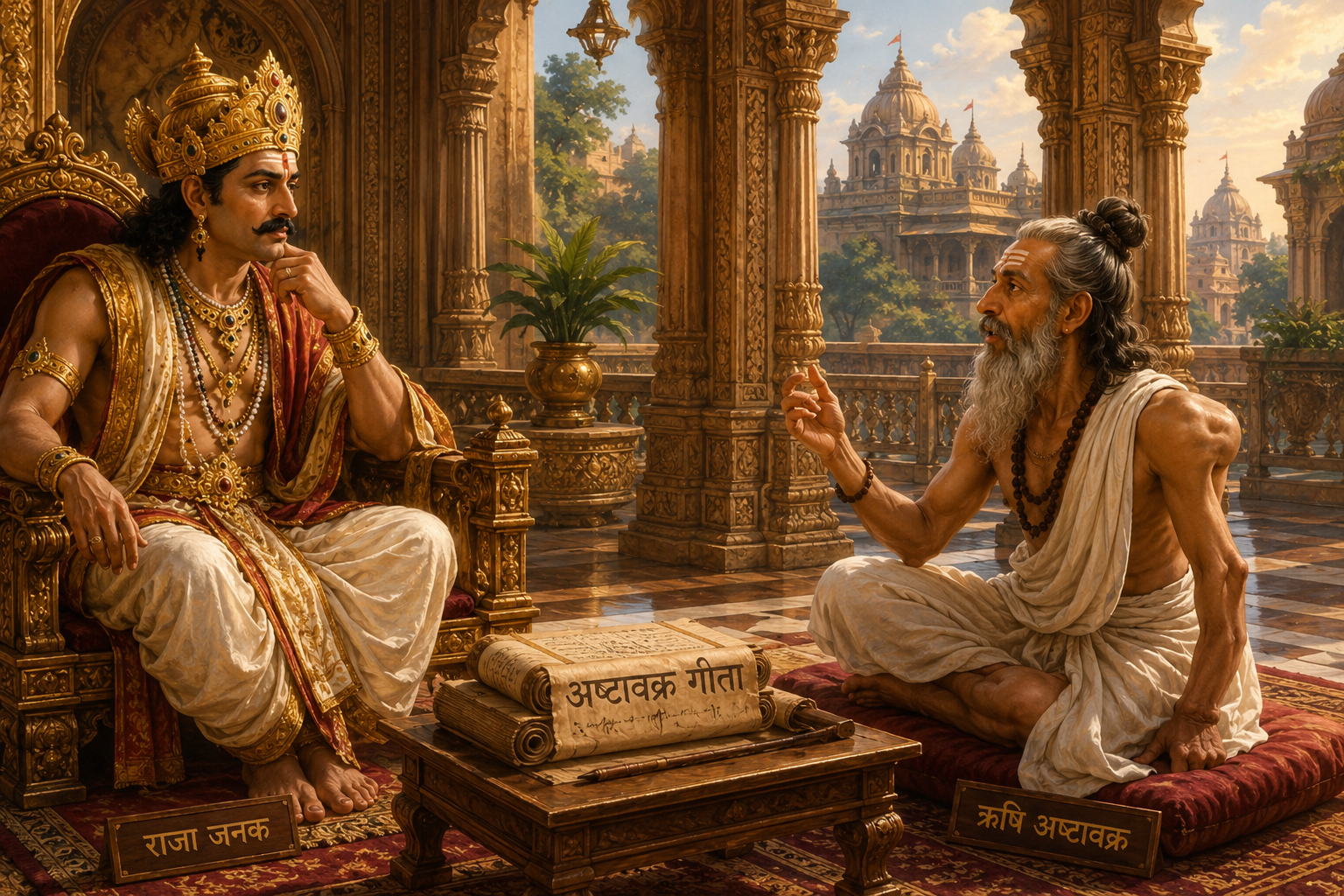
Ashtvakra Gita (Raja Janak and Rishi Ashtvakra Conversation)
About Course
ASHTAVAKRA GITA – COMPLETE SPIRITUAL WISDOM COURSE
The Ashtavakra Gita is one of the deepest and most powerful spiritual scriptures of ancient India. It is a divine dialogue between Sage Ashtavakra and King Janaka that reveals the highest truth of Self-Realization, inner freedom, peace, and liberation.
Unlike many scriptures that focus mainly on rituals or external practices, the Ashtavakra Gita directly teaches the path of pure awareness and Advaita Vedanta — the realization that the individual soul and the Supreme Consciousness are one.
This sacred scripture explains that human suffering comes from attachment, ego, desires, fear, ignorance, and identification with the body and mind. Sage Ashtavakra guides King Janaka toward the understanding that the true Self is eternal, pure, peaceful, beyond birth and death, and untouched by worldly problems.
The teachings of Ashtavakra Gita inspire seekers to rise above negativity, mental stress, emotional disturbance, anger, greed, jealousy, and illusion. It teaches how to remain calm and peaceful even in difficult situations and how to experience true freedom from within.
In this complete spiritual course, students will explore:
• The nature of the soul and consciousness
• Self-realization and liberation
• Freedom from attachment and ego
• Meditation and inner silence
• Witness consciousness
• The illusion of the material world
• Detachment and spiritual wisdom
• Peace, bliss, and enlightenment
• Practical spiritual understanding for modern life
This course is designed for spiritual seekers, yoga practitioners, meditation learners, philosophy students, and anyone searching for peace, wisdom, self-discovery, and higher consciousness.
Through detailed chapter explanations, lesson summaries, quizzes, and practical examples, learners will understand the timeless wisdom of Ashtavakra Gita in a simple and meaningful way.
The Ashtavakra Gita is not merely a book — it is a path toward inner awakening, truth, peace, and ultimate spiritual freedom.
“Know yourself as pure consciousness, and you shall be free.
Course Content
Chapter 1 — Self Knowledge (Atma Jnana) The Nature of the Self and Liberation
n the first chapter of Ashtavakra Gita, Sage Ashtavakra teaches King Janaka that true liberation comes through Self-Knowledge. He explains that a person is not merely the body, mind, emotions, or worldly identity, but the pure, eternal consciousness (Atman).
Ashtavakra says that attachment to desires, ego, anger, greed, and worldly illusion creates suffering. Freedom is achieved when a person realizes their true nature as the silent witness of all experiences.
The chapter emphasizes detachment, inner awareness, and freedom from mental bondage. It teaches that liberation is not obtained through rituals alone but through deep understanding of the Self.
Main teachings include:
* You are the soul, not the body.
* Attachment creates bondage.
* Awareness brings liberation.
* Peace comes from detachment.
* The wise remain calm in every situation.
Course Description
This chapter introduces the core philosophy of Ashtavakra Gita — Self-Realization through inner awareness. Students learn the difference between the temporary body and the eternal soul and discover how freedom from attachment leads to peace and spiritual awakening.
Chapter 2 — The Joy of Self-Realization (The Experience of Inner Freedom and Bliss)
In the second chapter of Ashtavakra Gita, King Janaka begins to experience the truth taught by Sage Ashtavakra. He realizes that the soul is beyond body, mind, emotions, and worldly identity. Janaka expresses the joy, peace, and freedom that arise from Self-Realization.
This chapter teaches that true happiness does not come from wealth, power, relationships, or external achievements. Real peace comes from understanding one’s true nature as pure consciousness.
Janaka realizes that the world constantly changes, but the Self remains eternal and untouched. He understands that attachment, ego, fear, and desire are illusions created by the mind.
The chapter explains that a wise person remains calm in success and failure, pleasure and pain, because they know the temporary nature of the world.
Main Teachings
* The Self is eternal and beyond suffering.
* True joy comes from inner realization.
* Attachment creates illusion and sorrow.
* Peace is found within, not outside.
* The realized person remains fearless and calm.
Course Description
This chapter explores the transformation of King Janaka after receiving spiritual wisdom from Sage Ashtavakra. Students learn how Self-Realization brings inner peace, freedom from fear, and lasting happiness beyond worldly desires.
Chapter 3 — Detachment from the World (Freedom Through Detachment and Inner Awareness
In the third chapter of Ashtavakra Gita, Sage Ashtavakra teaches that attachment to the world is the main cause of suffering and bondage. He explains that desires, possessions, ego, and constant mental involvement in worldly matters prevent a person from experiencing true peace.
This chapter emphasizes the importance of detachment (Vairagya). Detachment does not mean abandoning life or responsibilities, but remaining inwardly free from excessive attachment, greed, fear, and emotional dependence.
Ashtavakra says that the wise person lives in the world but remains untouched by it, just as a lotus flower remains untouched by water. A realized soul understands that everything in the material world is temporary and constantly changing.
The chapter encourages seekers to observe life with awareness and develop inner silence. Through detachment and Self-Knowledge, the mind becomes peaceful and the soul experiences freedom.
Main Teachings
* Attachment is the root cause of suffering.
* Everything in the world is temporary.
* True freedom comes through detachment.
* The wise remain peaceful amidst worldly changes.
* Inner awareness leads to liberation.
Course Description
This chapter teaches the spiritual principle of detachment and explains how freedom from excessive desires and attachments brings peace, clarity, and spiritual growth. Students learn how to live in the world while remaining inwardly calm and free.
Chapter 4 — The Glory of Self-Knowledge (The Power of Wisdom and the Nature of the Enlightened Soul)
In the fourth chapter of Ashtavakra Gita, Sage Ashtavakra explains the greatness of Self-Knowledge and the state of an enlightened person. He teaches that a wise person who realizes the true Self becomes free from fear, sorrow, ego, and attachment.
This chapter describes how the enlightened soul sees the world with equality and inner peace. Such a person no longer feels disturbed by praise or criticism, success or failure, gain or loss. The realized being understands that the soul is eternal, pure, and beyond all worldly changes.
Ashtavakra explains that ignorance creates the illusion of bondage, while wisdom destroys all confusion. The enlightened person lives naturally, peacefully, and without pride or selfish desires.
The chapter also teaches that external appearances do not determine spiritual greatness. A truly wise person may live simply, but inwardly remains established in supreme peace and awareness.
Main Teachings
* Self-Knowledge destroys ignorance.
* The enlightened soul remains peaceful in all situations.
* The true Self is beyond fear and sorrow.
* Wisdom brings freedom from ego and attachment.
* Inner realization is greater than external achievement.
Course Description
This chapter explains the greatness of spiritual wisdom and the qualities of an enlightened person. Students learn how Self-Knowledge transforms the mind, removes fear and attachment, and leads to lasting inner peace and liberation.
Chapter 5 — The Peace of Liberation (Inner Peace Through Freedom from Desire and Ego)
In the fifth chapter of Ashtavakra Gita, Sage Ashtavakra explains the peaceful state of a liberated soul. He teaches that true peace is attained when a person becomes free from ego, desires, attachment, and mental disturbance.
This chapter describes how worldly cravings constantly create restlessness and suffering. The enlightened person, however, remains content within because they no longer depend on external pleasures for happiness.
Ashtavakra says that the realized soul understands the temporary nature of the material world and therefore remains calm in all circumstances. Such a person neither becomes overly excited in success nor depressed in failure.
The chapter emphasizes inner silence, contentment, simplicity, and the joy of Self-Realization. A liberated person acts naturally without selfishness, pride, or fear, living in complete harmony with life.
Main Teachings
* True peace comes from within.
* Desires and ego create mental disturbance.
* The liberated soul remains calm in all situations.
* Contentment is greater than worldly pleasure.
* Self-Realization brings lasting happiness.
Course Description
This chapter teaches the nature of inner peace and liberation. Students learn how freedom from ego, attachment, and desire leads to spiritual joy, balance, and permanent peace of mind.
Chapter 5 — Renunciation and Inner Freedom(Freedom from Attachment and the Joy of Inner Peace)
In the fifth chapter of Ashtavakra Gita, Sage Ashtavakra teaches that true renunciation is not merely giving up worldly possessions, but freeing the mind from attachment, ego, fear, and desire.
He explains that many people appear spiritual externally but still remain mentally attached to wealth, praise, relationships, and worldly pleasures. Real liberation comes when the mind becomes peaceful and free from craving.
This chapter describes the state of a wise person who lives naturally and peacefully without being controlled by emotions or worldly expectations. Such a person understands that happiness does not come from external achievements but from realizing the true Self.
Ashtavakra says that when the mind becomes free from unnecessary desires and mental disturbances, the soul experiences deep peace, freedom, and bliss. The enlightened person remains calm in every situation because they know the temporary nature of worldly events.
The chapter also emphasizes simplicity, contentment, inner silence, and spiritual awareness as the foundation of liberation.
Main Teachings
* True renunciation is freedom from mental attachment.
* Desires create restlessness and suffering.
* Inner peace is greater than worldly pleasure.
* A wise person remains calm in all situations.
* Self-Realization brings lasting happiness and freedom.
Course Description
This chapter explains the deeper meaning of renunciation and spiritual freedom. Students learn how detachment from ego, desire, and worldly cravings leads to peace, balance, and liberation from suffering.
Chapter 6 — The State of the Enlightened Soul
Inner Stability, Awareness, and Freedom from Illusion
Lesson Summary
In the sixth chapter of Ashtavakra Gita, Sage Ashtavakra describes the qualities and state of an enlightened soul. He explains that a realized person remains inwardly peaceful, stable, and unaffected by worldly changes.
This chapter teaches that the enlightened being no longer identifies with the body, emotions, ego, or material possessions. Such a person understands that the true Self is pure consciousness, eternal, and beyond all suffering.
Ashtavakra says that ordinary people are constantly disturbed by desires, fear, attachment, praise, criticism, gain, and loss. But the wise person remains like the sky — vast, calm, and untouched by temporary events.
The chapter emphasizes awareness, simplicity, and witness consciousness. The enlightened soul performs actions naturally without selfishness or mental conflict. Such a person experiences freedom even while living in the world.
The teachings inspire seekers to rise above illusion, emotional instability, and mental restlessness, and to remain established in inner peace and spiritual awareness.
Main Teachings
* The true Self is beyond body and mind.
* The enlightened soul remains calm in all situations.
* Awareness destroys illusion and ignorance.
* Peace comes through witness consciousness.
* Freedom is experienced within, not outside.
Course Description
This chapter explains the qualities of an enlightened person and the peaceful state attained through Self-Realization. Students learn how awareness, detachment, and spiritual wisdom help overcome illusion and bring lasting inner stability.
Chapter 7 — The Nature of Freedom (The Freedom of the Soul Beyond Attachment and Illusion)
In the seventh chapter of Ashtavakra Gita, Sage Ashtavakra explains the true nature of spiritual freedom. He teaches that liberation is not something to be achieved externally, but a realization of the soul’s eternal and pure nature.
This chapter emphasizes that the soul is always free, but ignorance and attachment create the illusion of bondage. A person who identifies only with the body, mind, emotions, and worldly identity remains trapped in fear, desire, and suffering.
Ashtavakra says that the wise person realizes that all worldly experiences are temporary and therefore remains inwardly detached. Such a person acts naturally without ego, pride, or selfishness and remains peaceful even amidst challenges.
The chapter also teaches that freedom comes through awareness and witness consciousness. The enlightened soul observes life without becoming mentally disturbed by success, failure, praise, or criticism.
This chapter inspires seekers to rise above illusion and realize the eternal freedom of the Self.
Main Teachings
* The soul is naturally free and pure.
* Ignorance creates the illusion of bondage.
* Attachment leads to suffering and fear.
* Awareness brings spiritual freedom.
* The wise remain detached and peaceful.
Course Description
This chapter explains the spiritual meaning of true freedom and liberation. Students learn how ignorance and attachment create suffering, while Self-Realization and awareness lead to inner peace and eternal freedom.
Chapter 8 — Bondage and Freedom (Moksha) Understanding Bondage and Liberation
In the eighth chapter of Ashtavakra Gita, Sage Ashtavakra gives one of the most direct teachings on bondage and liberation. He explains that bondage is not created by the world itself, but by the movements of the mind — desire, attachment, anger, fear, acceptance, rejection, and ego.
Ashtavakra teaches that whenever the mind becomes attached to sense objects, emotions, pleasure, pain, success, or identity, bondage arises. Liberation begins when the mind becomes free from craving, resistance, and emotional disturbance.
The chapter emphasizes that freedom is not something to be achieved in the future. The soul is already free by nature. Only ignorance and mental identification create the illusion of bondage.
A realized person remains inwardly free whether surrounded by activity or silence. Such a person neither clings to worldly experiences nor runs away from them. They remain established in pure awareness and witness consciousness.
This chapter contains extremely deep Advaita teachings and explains that liberation is the absence of ego and mental attachment.
Main Teachings
* Bondage is created by the mind.
* Desire and attachment create suffering.
* Ego creates the illusion of limitation.
* Liberation is freedom from mental disturbance.
* The Self is already free and pure.
* Witness consciousness leads to peace.
Course Description
This chapter explains the real meaning of bondage and liberation according to Advaita Vedanta. Students learn how desires, ego, attachment, and emotional reactions bind the mind, while awareness and detachment reveal the soul’s natural freedom and peace.
Chapter 9 — The Witness Consciousness (Living as the Silent Witness of the Mind and World)
In the ninth chapter of Ashtavakra Gita, Sage Ashtavakra explains the profound teaching of Witness Consciousness (Sakshi Bhava). He teaches King Janaka that the true Self is not the body, mind, emotions, thoughts, or actions, but the silent witness that observes all experiences.
Ashtavakra says that most human suffering comes from identification with thoughts, desires, emotions, and worldly situations. People constantly become attached to what the mind experiences — happiness, sadness, praise, criticism, success, and failure. Because of this identification, the mind remains restless and disturbed.
The enlightened person, however, remains established as the witness. Such a person observes thoughts, emotions, and life events without becoming mentally trapped by them. Just as the sky remains untouched by clouds, the Self remains untouched by the changing experiences of life.
This chapter teaches that the world, body, and mind continuously change, but pure awareness remains constant and eternal. Through deep awareness and detachment, one realizes inner peace, freedom, and spiritual stability.
Ashtavakra emphasizes that liberation is not obtained by controlling every external event, but by remaining established in witness consciousness beyond attachment and ego.
Main Teachings
* The true Self is the silent witness.
* Thoughts and emotions are temporary.
* Attachment to mental experiences creates suffering.
* Witness consciousness brings peace and freedom.
* The soul remains untouched by worldly changes.
* Awareness is greater than mental activity.
* The wise observe life without attachment.
Course Description
This chapter teaches the powerful spiritual principle of Witness Consciousness. Students learn how to observe thoughts, emotions, and life situations with awareness and detachment, leading toward peace, inner stability, and Self-Realization.
Chapter 10 — Inner Stillness and Silence(The Peace Beyond Thoughts and Mental Activity)
In the tenth chapter of Ashtavakra Gita, Sage Ashtavakra teaches King Janaka about the deep state of inner stillness and silence that arises after Self-Realization. He explains that the restless mind constantly creates disturbance through thoughts, desires, fears, memories, expectations, and emotional reactions.
The chapter teaches that true peace is not achieved by controlling every external situation, but by transcending unnecessary mental activity. When the mind becomes silent and free from attachment, the soul naturally experiences bliss, clarity, and freedom.
Ashtavakra says that an enlightened person remains inwardly silent even while performing worldly actions. Such a person is no longer controlled by praise or criticism, gain or loss, success or failure. Their peace comes from within, not from changing external circumstances.
This chapter emphasizes the importance of inner stillness, effortless awareness, and freedom from overthinking. The realized soul lives naturally, peacefully, and spontaneously without mental conflict.
The teachings encourage seekers to move beyond constant mental noise and discover the deep silence of pure consciousness.
Main Teachings
* True peace exists beyond restless thoughts.
* The mind creates disturbance through attachment and fear.
* Inner silence leads to clarity and bliss.
* The enlightened person remains peaceful in all situations.
* Freedom comes through effortless awareness.
* Silence and stillness reveal the true Self.
* Real happiness comes from within.
Course Description
This chapter explains the spiritual importance of inner silence and stillness. Students learn how freedom from mental restlessness leads to peace, clarity, awareness, and deeper realization of the eternal Self.
Chapter 11 — The Peace of the Wise (Inner Peace, Detachment, and the Natural State of the Enlightened Soul)
In the eleventh chapter of Ashtavakra Gita, Sage Ashtavakra explains the peaceful and natural state of a wise and enlightened person. He teaches that true wisdom brings deep inner silence, freedom from mental disturbance, and complete detachment from worldly illusion.
This chapter describes how the enlightened soul remains calm and unaffected by desires, fears, success, failure, praise, criticism, gain, or loss. Such a person understands that the material world is temporary and constantly changing, while the true Self remains eternal, pure, and untouched.
Ashtavakra explains that ordinary people become trapped in endless thoughts, emotions, and worldly attachment, but the realized person rests in pure awareness and inner peace. The wise do not struggle unnecessarily with life because they have gone beyond ego and mental conflict.
The chapter also teaches that liberation is not something to be achieved in the future — it is the natural state of the Self when ignorance disappears. A person who realizes this truth becomes free from fear, sorrow, attachment, and restlessness.
This chapter inspires seekers to live with simplicity, awareness, silence, and spiritual understanding while remaining inwardly free and peaceful.
Main Teachings
* The true Self is naturally peaceful and free.
* Attachment and mental disturbance create suffering.
* The enlightened soul remains calm in all situations.
* Liberation is the natural state of the Self.
* Inner silence and awareness bring lasting peace.
Course Description
This chapter explains the peaceful nature of the enlightened soul and the freedom that comes through Self-Realization. Students learn how detachment, awareness, and inner silence remove suffering and reveal the natural peace of the Self.
Chapter 12 — Beyond Attachment and Desire (Freedom from Desire and the Bliss of Pure Awareness)
In the twelfth chapter of Ashtavakra Gita, Sage Ashtavakra teaches that true freedom is attained when the mind becomes free from desires, attachment, ego, and worldly craving. He explains that desires constantly create restlessness, dissatisfaction, fear, and suffering in human life.
This chapter emphasizes that the enlightened person no longer seeks happiness from external objects, praise, relationships, or material achievements. Instead, the wise remain established in pure awareness and inner contentment.
Ashtavakra explains that attachment to temporary things creates bondage, while detachment brings peace and liberation. A person who realizes the eternal nature of the Self naturally becomes calm, fearless, and free from mental conflict.
The chapter also teaches that the soul is complete and perfect by nature. When a seeker stops chasing temporary pleasures and realizes the Self, deep peace and bliss arise naturally from within.
This chapter inspires spiritual seekers to live with simplicity, awareness, detachment, and inner silence while remaining free from unnecessary desires and emotional disturbance.
Main Teachings
* Desires create suffering and restlessness.
* True happiness comes from within.
* Attachment creates bondage.
* The enlightened soul remains content and peaceful.
* Pure awareness leads to liberation and bliss.
Course Description
This chapter explains how freedom from desire and attachment brings lasting peace and spiritual bliss. Students learn the importance of inner awareness, contentment, and Self-Realization in overcoming suffering and mental disturbance.
Chapter 13 — The Witness Consciousness (The Soul as the Silent Witness Beyond Mind and Body)
In the thirteenth chapter of Ashtavakra Gita, Sage Ashtavakra explains the concept of witness consciousness — the understanding that the true Self is the silent observer of the body, mind, thoughts, emotions, and worldly experiences.
He teaches King Janaka that most human suffering comes from identifying with the body and mind. People become trapped in fear, desire, anger, attachment, and ego because they believe themselves to be the doer and experiencer of all actions.
Ashtavakra explains that the enlightened person realizes that the Self is pure consciousness — untouched by worldly events, emotions, success, failure, pleasure, or pain. Just as the sky remains unaffected by clouds, the true Self remains untouched by mental and physical changes.
This chapter encourages seekers to observe thoughts and experiences without attachment and to remain established in awareness and inner silence. The witness consciousness brings freedom from fear, emotional disturbance, and suffering.
The chapter also teaches that liberation arises naturally when one stops identifying with temporary worldly experiences and realizes the eternal nature of the Self.
Main Teachings
* The true Self is the silent witness.
* Identification with the mind creates suffering.
* Awareness brings freedom and peace.
* The soul remains untouched by worldly changes.
* Witness consciousness leads to liberation.
Course Description
This chapter teaches the spiritual principle of witness consciousness and explains how observing life with awareness leads to peace, detachment, and Self-Realization. Students learn how to remain inwardly calm and free amidst worldly experiences.
Chapter 14 — Freedom from Mental Bondage (Liberation Through Detachment and Inner Awareness)
In the fourteenth chapter of Ashtavakra Gita, Sage Ashtavakra explains how the mind creates bondage through attachment, desires, fear, ego, and constant thinking. He teaches that true liberation is attained when a person rises above mental disturbances and realizes the peaceful nature of the Self.
This chapter emphasizes that the world itself is not the cause of suffering — attachment and identification with thoughts and emotions create suffering. The ignorant person becomes trapped in mental conflict, expectations, and emotional reactions, while the enlightened soul remains calm, detached, and free.
Ashtavakra says that the wise person lives naturally without excessive worry, pride, greed, or attachment. Such a person understands that all worldly experiences are temporary and therefore remains established in inner awareness and peace.
The chapter also teaches the importance of observing the mind without becoming controlled by it. Through awareness and Self-Knowledge, mental bondage disappears and the soul experiences freedom, silence, and bliss.
This chapter inspires seekers to overcome fear, emotional instability, and mental restlessness through detachment, wisdom, and witness consciousness.
Main Teachings
* The mind creates bondage and suffering.
* Attachment strengthens mental disturbance.
* Awareness brings freedom from fear and ego.
* The wise remain detached and peaceful.
* Self-Knowledge leads to liberation and bliss.
Course Description
This chapter explains how attachment and mental identification create suffering and how awareness and detachment bring inner freedom. Students learn how to observe the mind calmly and remain established in peace and spiritual awareness.
Chapter 15 — The Natural State of the Self (Effortless Peace and the Spontaneous Nature of Enlightenment)
In the fifteenth chapter of Ashtavakra Gita, Sage Ashtavakra explains that the true Self is naturally free, peaceful, pure, and complete. He teaches King Janaka that enlightenment is not something artificially created through struggle, but the natural state of consciousness revealed when ignorance disappears.
This chapter emphasizes effortless awareness and spontaneous inner peace. Ashtavakra explains that the ignorant mind constantly seeks control, achievement, pleasure, recognition, and security, while the enlightened person rests naturally in the Self without mental conflict.
The wise person no longer becomes disturbed by worldly events because they understand that all experiences are temporary appearances within consciousness. Such a person acts naturally, without ego, pride, fear, or attachment.
Ashtavakra also teaches that liberation does not require extreme external renunciation or complicated practices. When the mind becomes quiet and attachment disappears, the soul naturally shines in its original state of peace and bliss.
The chapter encourages seekers to stop excessive mental struggle and rest in pure awareness, simplicity, silence, and inner freedom.
Main Teachings
* The Self is naturally free and complete.
* Enlightenment is the natural state of consciousness.
* Mental struggle creates suffering.
* The wise live effortlessly and peacefully.
* Inner silence reveals true freedom and bliss.
Course Description
This chapter teaches the effortless and natural nature of enlightenment according to Ashtavakra Gita. Students learn how freedom, peace, and bliss arise naturally when attachment, ego, and mental conflict disappear.
Chapter 16 — Freedom Beyond Duality (Going Beyond Attachment, Ego, and the Illusion of Opposites )
In the sixteenth chapter of Ashtavakra Gita, Sage Ashtavakra teaches that true liberation is attained when a person rises above duality and mental division. He explains that ordinary people constantly remain trapped in opposites such as happiness and sorrow, success and failure, praise and criticism, attachment and hatred.
Ashtavakra says that these dualities belong to the mind, not to the true Self. The enlightened person understands that the soul is beyond all changing experiences and therefore remains peaceful and balanced in every situation.
This chapter emphasizes freedom from ego, comparison, judgment, emotional dependence, and mental conflict. The wise person neither becomes proud in success nor depressed in failure because they know the temporary nature of worldly events.
Ashtavakra explains that when attachment to opposites disappears, the mind becomes silent and the soul experiences natural bliss and freedom. The realized person lives with simplicity, awareness, and effortless peace.
The chapter also teaches that the Self is beyond good and bad, gain and loss, and all mental categories created by the ego. Through Self-Knowledge and inner awareness, a seeker transcends illusion and experiences non-dual consciousness.
Main Teachings
* Duality creates mental suffering and conflict.
* The true Self is beyond opposites.
* Ego and comparison disturb inner peace.
* The wise remain balanced in all situations.
* Non-dual awareness leads to liberation and bliss.
Course Description
This chapter explains the spiritual freedom that arises when a seeker goes beyond mental duality and worldly opposites. Students learn how non-dual awareness, detachment, and inner balance bring peace, freedom, and Self-Realization.
Chapter 17 — The Wisdom of the Detached Sage ( The Peaceful Life of One Established in Self-Knowledge )
In the seventeenth chapter of Ashtavakra Gita, Sage Ashtavakra describes the qualities and inner state of a truly wise and detached sage. He explains that a person established in Self-Knowledge lives with complete inner freedom, peace, simplicity, and natural awareness.
This chapter teaches that the enlightened person no longer becomes controlled by desires, ego, fear, praise, criticism, success, or failure. Such a sage remains inwardly peaceful because they understand the temporary and illusory nature of worldly experiences.
Ashtavakra says that the wise do not struggle to prove themselves, control others, or seek validation from society. Their happiness does not depend on external conditions because they remain established in the bliss of the Self.
The chapter also emphasizes effortless living, contentment, silence, and non-attachment. The detached sage performs actions naturally without selfish motives or mental conflict. Such a person neither clings to pleasure nor fears pain.
Ashtavakra explains that true wisdom is not merely intellectual knowledge but direct realization of one’s eternal nature as pure consciousness. This realization brings spontaneous peace, fearlessness, and freedom from suffering.
The chapter inspires seekers to cultivate simplicity, awareness, detachment, and inner stillness while remaining free from unnecessary desires and emotional disturbance.
Main Teachings
* The enlightened sage remains peaceful and detached.
* True happiness comes from the Self, not the world.
* Ego and desire create suffering and restlessness.
* Wisdom brings fearlessness and contentment.
* Effortless awareness leads to liberation.
Course Description
This chapter explains the peaceful and detached life of a spiritually realized sage. Students learn how Self-Knowledge, simplicity, and inner awareness bring freedom from suffering and lasting spiritual peace.
Chapter 18 — The Final Realization of Freedom ( Complete Liberation Through Self-Realization and Inner Silence )
In the eighteenth and final chapter of Ashtavakra Gita, Sage Ashtavakra concludes his teachings by explaining the highest state of spiritual realization and absolute freedom. He teaches King Janaka that true liberation is attained when all attachment, ego, fear, desire, mental conflict, and illusion completely disappear.
This chapter describes the state of a fully enlightened soul who lives in perfect peace, inner silence, and effortless awareness. Such a person no longer identifies with the body, mind, emotions, or worldly identity and remains established in pure consciousness.
Ashtavakra explains that the realized being neither seeks worldly pleasure nor fears pain. The wise person understands that all worldly experiences are temporary appearances within consciousness and therefore remains naturally free from suffering and emotional disturbance.
The chapter emphasizes spontaneity, simplicity, fearlessness, and complete inner freedom. The enlightened sage lives without ego, pride, attachment, comparison, or mental struggle. Such a person acts naturally and peacefully while remaining inwardly untouched by worldly events.
Ashtavakra also teaches that liberation is not something to be created or achieved externally. The Self is already free, pure, complete, and divine. When ignorance disappears through Self-Knowledge, the natural bliss of the soul shines automatically.
The final chapter inspires seekers to realize their true nature as eternal consciousness and to live with peace, awareness, detachment, wisdom, and spiritual freedom.
Main Teachings
* The true Self is eternally free and complete.
* Ego, attachment, and ignorance create suffering.
* Liberation comes through Self-Realization.
* The enlightened soul remains peaceful and fearless.
* Inner silence reveals the bliss of pure consciousness.
* Freedom is the natural state of the soul.
* Awareness destroys illusion and mental bondage.
Course Description
This final chapter summarizes the highest teachings of Ashtavakra Gita and explains the ultimate state of liberation, peace, and Self-Realization. Students learn how freedom from ego, attachment, and illusion reveals the natural bliss and completeness of the eternal Self.
Chapter 19 — The Vision of the Liberated Soul ( Seeing the World Through Pure Consciousness )
In the nineteenth chapter of Ashtavakra Gita, Sage Ashtavakra explains the vision and understanding of a liberated soul. He teaches that an enlightened person sees the entire world as a manifestation appearing within pure consciousness and no longer becomes trapped in illusion, fear, ego, or attachment.
This chapter emphasizes that ordinary people constantly divide life into good and bad, pleasure and pain, gain and loss. But the realized person understands that all experiences arise and disappear within awareness like waves in the ocean.
Ashtavakra explains that the wise person remains inwardly untouched by worldly situations because they no longer identify themselves with temporary thoughts, emotions, or external conditions. Such a person lives in spontaneous peace, freedom, and natural joy.
The chapter also teaches that liberation is not escaping the world, but seeing the world through wisdom and awareness. The enlightened soul acts naturally without selfishness, fear, or attachment and remains established in the bliss of the Self.
Ashtavakra encourages seekers to develop witness consciousness and realize that the true Self is vast, pure, eternal consciousness beyond all mental limitations and worldly illusion.
Main Teachings
* The world appears within consciousness.
* The liberated soul remains untouched by worldly events.
* Awareness destroys illusion and fear.
* Witness consciousness brings freedom and peace.
* The wise see unity beyond worldly divisions.
* True joy comes from Self-Realization.
Course Description
This chapter explains the spiritual vision of the enlightened soul and teaches how awareness transforms one’s understanding of life and the world. Students learn how witness consciousness and Self-Knowledge bring peace, freedom, and non-dual awareness.
Chapter 20 — Supreme Peace and Liberation ( The Ultimate State of Freedom, Bliss, and Pure Consciousness )
In the twentieth and concluding chapter of Ashtavakra Gita, Sage Ashtavakra presents the final and highest vision of spiritual liberation. He explains that the true Self is eternal, limitless, pure consciousness beyond all worldly illusion, mental disturbance, fear, attachment, and suffering.
This chapter describes the supreme peace experienced by an enlightened soul who has completely transcended ego, desire, duality, and identification with the body and mind. The liberated person no longer seeks fulfillment from external objects because they remain established in the bliss of the Self.
Ashtavakra teaches that the world constantly changes, but the Self remains forever untouched, silent, peaceful, and complete. The realized person neither clings to pleasure nor fears pain and remains inwardly free in every situation.
The chapter emphasizes effortless awareness, complete detachment, simplicity, fearlessness, and natural inner silence. The wise person no longer struggles with life because they understand the illusory and temporary nature of worldly experiences.
Ashtavakra finally guides seekers toward the direct realization that liberation is not something to be achieved externally — it is the eternal nature of consciousness itself. When ignorance disappears, the soul naturally shines in its original state of peace, wisdom, and bliss.
This final chapter inspires seekers to live with awareness, peace, detachment, compassion, and spiritual freedom while remaining established in the eternal Self.
Main Teachings
* The Self is eternal, pure, and limitless consciousness.
* Liberation is the natural state of the soul.
* Ego, attachment, and ignorance create suffering.
* The enlightened remain peaceful and fearless.
* Inner silence reveals true bliss and freedom.
* The wise live effortlessly and without mental conflict.
* Self-Realization brings complete liberation.
Course Description
This final chapter summarizes the highest teachings of Ashtavakra Gita and explains the ultimate state of liberation, peace, awareness, and Self-Realization. Students learn how freedom from ego, attachment, and illusion reveals the eternal bliss of pure consciousness.
Final Course Conclusion ( Living the Wisdom of Ashtavakra Gita in Daily Life )
This concluding section summarizes the timeless teachings of Ashtavakra Gita and explains how Self-Knowledge, awareness, detachment, inner silence, and spiritual wisdom can be applied in modern life. Students are encouraged to practice witness consciousness, simplicity, compassion, and inner peace while remaining free from ego, fear, and attachment.
Student Ratings & Reviews